


Page 1023 - How to Make Money in Stocks Trilogy
P. 1023
16  HOW TO MAKE MONEY IN STOCKS—GETTING STARTED


         year after year, decade after decade, the biggest winners display these same
         7 CAN SLIM traits just before they launch their massive runs.
           The company names will change, new technology and industries will
         emerge, but  the basic profile and attributes of an emerging big winner
         always look the same. So once you understand what to look for, your search
         for the next game-changing stock won’t be based on hunches or hype. It’ll
         be based on history and a targeted checklist of specific, telltale signs.
           Only about 1% to 2% of all stocks will have these CAN SLIM character-
         istics. But as the results of an independent study by the American
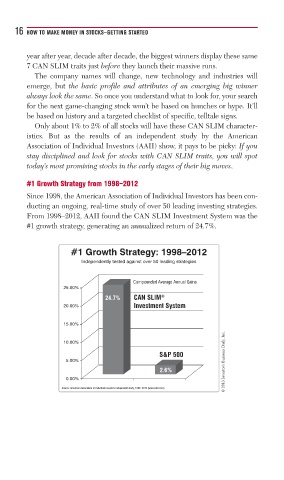
         Association of Individual Investors (AAII) show, it pays to be picky: If you
         stay disciplined and look for stocks with CAN SLIM traits, you will spot
         today’s most promising stocks in the early stages of their big moves.

         #1 Growth Strategy from 1998–2012
         Since 1998, the American Association of Individual Investors has been con-
         ducting an ongoing, real-time study of over 50 leading investing strategies.
         From 1998–2012, AAII found the CAN SLIM Investment System was the
         #1 growth strategy, generating an annualized return of 24.7%.


                     #1 Growth Strategy: 1998–2012
                        Independently tested against over 50 leading strategies

                                      Compounded Average Annual Gains
                   25.00%
                                              ®
                               24.7%   CAN SLIM
                   20.00%              Investment System
                   15.00%
                                                                © 2013 Investor’s Business Daily, Inc.
                   10.00%
                                              S&P 500
                    5.00%
                                              2.6%
                    0.00%
                  Source: American Association of Individual Investors independent study, 1998–2012 (www.AAII.com)

