


Page 334 - KSPK ENGLISH LANGUAGE
P. 334
3) After-song, chant or rhyme activity– focus on understanding and creativity
Encourage expansion
If suitable, help children substitute words and create a new song, chant or rhyme.
Present the song, chant or rhyme to an audience.
Record the song, chant or rhyme and make it available on the school website or on a class blog.
Nursery rhymes in particular
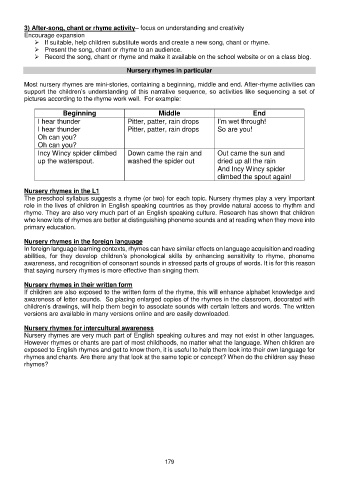
Most nursery rhymes are mini-stories, containing a beginning, middle and end. After-rhyme activities can
support the children’s understanding of this narrative sequence, so activities like sequencing a set of
pictures according to the rhyme work well. For example:
Beginning Middle End
I hear thunder Pitter, patter, rain drops I’m wet through!
I hear thunder Pitter, patter, rain drops So are you!
Oh can you?
Oh can you?
Incy Wincy spider climbed Down came the rain and Out came the sun and
up the waterspout. washed the spider out dried up all the rain
And Incy Wincy spider
climbed the spout again!
Nursery rhymes in the L1
The preschool syllabus suggests a rhyme (or two) for each topic. Nursery rhymes play a very important
role in the lives of children in English speaking countries as they provide natural access to rhythm and
rhyme. They are also very much part of an English speaking culture. Research has shown that children
who know lots of rhymes are better at distinguishing phoneme sounds and at reading when they move into
primary education.
Nursery rhymes in the foreign language
In foreign language learning contexts, rhymes can have similar effects on language acquisition and reading
abilities, for they develop children’s phonological skills by enhancing sensitivity to rhyme, phoneme
awareness, and recognition of consonant sounds in stressed parts of groups of words. It is for this reason
that saying nursery rhymes is more effective than singing them.
Nursery rhymes in their written form
If children are also exposed to the written form of the rhyme, this will enhance alphabet knowledge and
awareness of letter sounds. So placing enlarged copies of the rhymes in the classroom, decorated with
children’s drawings, will help them begin to associate sounds with certain letters and words. The written
versions are available in many versions online and are easily downloaded.
Nursery rhymes for intercultural awareness
Nursery rhymes are very much part of English speaking cultures and may not exist in other languages.
However rhymes or chants are part of most childhoods, no matter what the language. When children are
exposed to English rhymes and get to know them, it is useful to help them look into their own language for
rhymes and chants. Are there any that look at the same topic or concept? When do the children say these
rhymes?
179

