


Page 3 - Science 8th English chapter 1
P. 3
Characteristics :
                1. These are non-green, eukaryotic, heterotrophic organisms.
                2. Most of them are saprotrophs. They feed upon decaying organic
                   matter.
                3. Their cell wall is made up of tough and complex sugar called
                   ‘Chitin’.
                4. Some fungi are thread like and many nuclei are present in the
                   cytoplasm.
                5. Examples-  Baker’s yeast,  Aspergillus (Fungus on corn),
                   Penicillium, Mushrooms.
                     Though many systems of classification are introduced after the
                Whittaker's, his five kingdom system is widely accepted.


                                              Explain  merits and demerits  of
                       Use your brain power
                                              Whittaker’s classification.

                Classification of Microbes
                     Among the  living  organisms, microorganisms  are largest  in
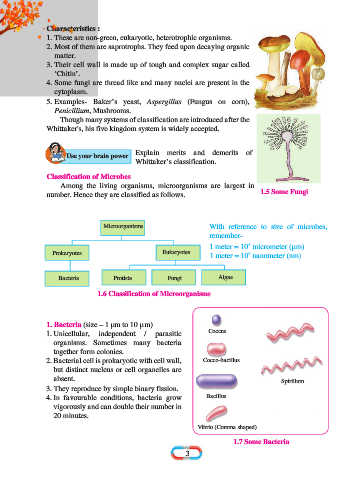
                number. Hence they are classified as follows.                          1.5 Some Fungi


                                   Microorganisms                     With  reference  to  size  of microbes,
                                                                      remember-
                                                                      1 meter = 10  micrometer (mm)
                                                                                   6
                  Prokaryotes                         Eukaryotes      1 meter = 10  nanometer (nm)
                                                                                   9


                     Bacteria         Protista          Fungi            Algae

                                 1.6 Classification of Microorganisms


                1. Bacteria (size – 1 mm to 10 mm)
                1. Unicellular,  independent  / parasitic             Coccus
                  organisms.  Sometimes  many  bacteria
                  together form colonies.
                2. Bacterial cell is prokaryotic with cell wall,    Cocco-bacillus
                  but distinct nucleus or cell organelles are
                  absent.                                                                     Spirillum
                3. They reproduce by simple binary fission.
                4. In favourable  conditions,  bacteria  grow        Bacillus
                  vigorously and can double their number in
                  20 minutes.

                                                                  Vibrio (Comma shaped)
                                                                              1.7 Some Bacteria

                                                              3

