


Page 4 - Science 8th English chapter 1
P. 4
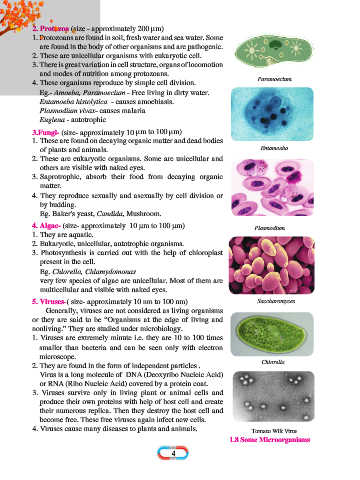
2. Protozoa (size - approximately 200 mm)
           1. Protozoans are found in soil, fresh water and sea water. Some
              are found in the body of other organisms and are pathogenic.
           2. These are unicellular organisms with eukaryotic cell.
           3. There is great variation in cell structure, organs of locomotion
              and modes of nutrition among protozoans.                                Paramoecium
           4. These organisms reproduce by simple cell division.
             Eg.- Amoeba, Paramoecium - Free living in dirty water.
             Entamoeba histolytica  - causes amoebiasis.
             Plasmodium vivax- causes malaria
             Euglena - autotrophic
           3.Fungi- (size- approximately 10 mm to 100 mm)
           1. These are found on decaying organic matter and dead bodies
              of plants and animals.                                                   Entamoeba
           2. These are eukaryotic organisms. Some are unicellular and
              others are visible with naked eyes.
           3. Saprotrophic,  absorb their  food from decaying organic
              matter.
           4. They reproduce sexually and asexually by cell division or
              by budding.
             Eg. Baker's yeast, Candida, Mushroom.

           4. Algae- (size- approximately  10 mm to 100 mm)                          Plasmodium
           1. They are aquatic.
           2.  Eukaryotic, unicellular, autotrophic organisms.
           3. Photosynthesis is carried out with the help of chloroplast
              present in the cell.
             Eg. Chlorella, Chlamydomonas
             very few species of algae are unicellular. Most of them are
              multicellular and visible with naked eyes.

           5. Viruses-( size- approximately 10 nm to 100 nm)                          Saccharomyces
                Generally, viruses are not considered as living organisms
           or they are said to be “Organisms at the edge of living and
           nonliving.” They are studied under microbiology.
           1. Viruses are extremely minute i.e. they are 10 to 100 times
              smaller than bacteria and can be seen only with electron
              microscope.
           2. They are found in the form of independent particles .                    Chlorella
             Virus is a long molecule of  DNA (Deoxyribo Nucleic Acid)
              or RNA (Ribo Nucleic Acid) covered by a protein coat.
           3.  Viruses survive  only  in  living  plant  or animal  cells  and
              produce their own proteins with help of host cell and create
              their numerous replica. Then they destroy the host cell and
              become free. These free viruses again infect new cells.
           4. Viruses cause many diseases to plants and animals.                    Tomato Wilt Virus
                                                                             1.8 Some Microorganisms

                                                          4

