


Page 18 - SK Year 5 Mathematics DLP
P. 18
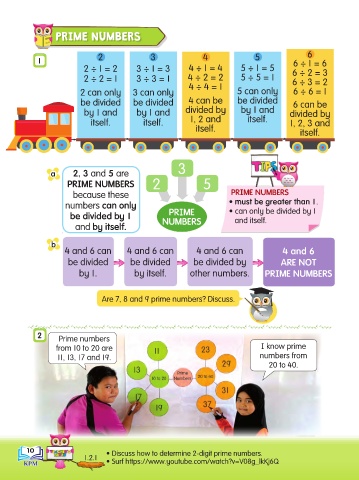
PRIME NUMBERS


                                   2               3               4              5               6
                 1                                                                            6 ÷ 1 = 6
                               2 ÷ 1 = 2       3 ÷ 1 = 3       4 ÷ 1 = 4      5 ÷ 1 = 5       6 ÷ 2 = 3
                               2 ÷ 2 = 1       3 ÷ 3 = 1      4 ÷ 2 = 2       5 ÷ 5 = 1       6 ÷ 3 = 2
                                                               4 ÷ 4 = 1
                              2 can only      3 can only                     5 can only       6 ÷ 6 = 1
                              be divided      be divided      4 can be       be divided       6 can be
                               by 1 and        by 1 and      divided by       by 1 and       divided by
                                 itself.         itself.       1, 2 and         itself.      1, 2, 3 and
                                                                 itself.
                                                                                                itself.


                                                           3
                     a      2, 3 and 5 are
                          PRIME NUMBERS             2              5
                            because these                                   PRIME NUMBERS
                         numbers can only                                  • must be greater than 1.
                                                                           • can only be divided by 1
                           be divided by 1               PRIME              and itself.
                            and by itself.             NUMBERS

                     b
                         4 and 6 can        4 and 6 can          4 and 6 can               4 and 6
                          be divided         be divided         be divided by             ARE NOT
                              by 1.           by itself.       other numbers.        PRIME NUMBERS


                                    Are 7, 8 and 9 prime numbers? Discuss.


                 2     Prime numbers

                       from 10 to 20 are                                            I know prime
                       11, 13, 17 and 19.                                           numbers from
                                                                                       20 to 40.


              10                      • Discuss how to determine 2-digit prime numbers.
                               1.2.1
                                      • Surf https://www.youtube.com/watch?v=V08g_lkKj6Q

