


Page 114 - SK Year 6 English
P. 114
Reading


                         Let’s read.
                 Najmee is reading about the traditional accessories worn
                 Najmee is reading about the traditional accessories worn
                 at the Gawai Dayak festival.
                 at the Gawai Dayak festival.
                 Gawai Dayak is a festival celebrated in Sarawak on the 1st and 2nd June every
                 year. The Gawai Dayak is celebrated by the Dayaks. During this festival, a
                 traditional dance called the Ngajat is performed.
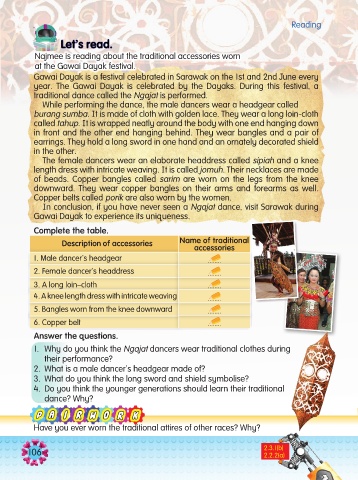
                   While performing the dance, the male dancers wear a headgear called
                 burang sumba. It is made of cloth with golden lace. They wear a long loin-cloth
                 called tahup. It is wrapped neatly around the body with one end hanging down
                 in front and the other end hanging behind. They wear bangles and a pair of
                 earrings. They hold a long sword in one hand and an ornately decorated shield
                 in the other.
                   The female dancers wear an elaborate headdress called sipiah and a knee
                 length dress with intricate weaving. It is called jomuh. Their necklaces are made
                 of beads. Copper bangles called sarim are worn on the legs from the knee
                 downward. They wear copper bangles on their arms and forearms as well.
                 Copper belts called porik are also worn by the women.
                   In conclusion, if you have never seen a Ngajat dance, visit Sarawak during
                 Gawai Dayak to experience its uniqueness.
                 Complete the table.

                         Description of accessories          Name of traditional
                                                                 accessories
                 1. Male dancer’s headgear

                 2. Female dancer’s headdress
                 3. A long loin–cloth
                 4. A knee length dress with intricate weaving

                 5. Bangles worn from the knee downward

                 6. Copper belt
                 Answer the questions.
                 1.  Why do you think the Ngajat dancers wear traditional clothes during
                    their performance?
                 2.  What is a male dancer’s headgear made of?
                 3.  What do you think the long sword and shield symbolise?
                 4.  Do you think the younger generations should learn their traditional
                    dance? Why?


                 Have you ever worn the traditional attires of other races? Why?


                                                                                      2.3.1(b)
               106                                                                    2.2.2(a)


         UNIT 11.indd   106                                                                             10/15/15   1:00 PM

