


Page 17 - SP015 Past Years PSPM Chapter 6 -14 Ver 2020
P. 17
PSPM SP015
PSPM 2015/2016 SF016/2 No. 5(a)
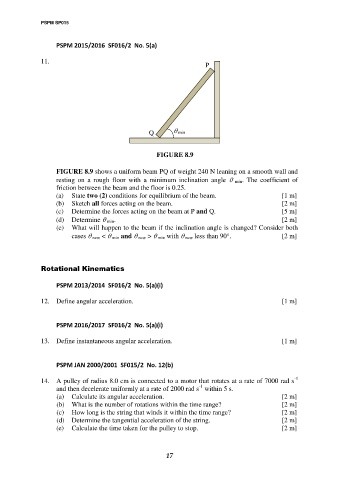
11. P
Q min
FIGURE 8.9
FIGURE 8.9 shows a uniform beam PQ of weight 240 N leaning on a smooth wall and
resting on a rough floor with a minimum inclination angle min. The coefficient of
friction between the beam and the floor is 0.25.
(a) State two (2) conditions for equilibrium of the beam. [1 m]
(b) Sketch all forces acting on the beam. [2 m]
(c) Determine the forces acting on the beam at P and Q. [5 m]
(d) Determine min. [2 m]
(e) What will happen to the beam if the inclination angle is changed? Consider both
cases new < min and new > min with new less than 90. [2 m]
Rotational Kinematics
PSPM 2013/2014 SF016/2 No. 5(a)(i)
12. Define angular acceleration. [1 m]
PSPM 2016/2017 SF016/2 No. 5(a)(i)
13. Define instantaneous angular acceleration. [1 m]
PSPM JAN 2000/2001 SF015/2 No. 12(b)
-1
14. A pulley of radius 8.0 cm is connected to a motor that rotates at a rate of 7000 rad s
-1
and then decelerate uniformly at a rate of 2000 rad s within 5 s.
(a) Calculate its angular acceleration. [2 m]
(b) What is the number of rotations within the time range? [2 m]
(c) How long is the string that winds it within the time range? [2 m]
(d) Determine the tangential acceleration of the string. [2 m]
(e) Calculate the time taken for the pulley to stop. [2 m]
17

