


Page 61 - SP015 Past Years PSPM Chapter 6 -14 Ver 2020
P. 61
PSPM SP015
PSPM 2005/2006 SF017/2 No. 7
10.
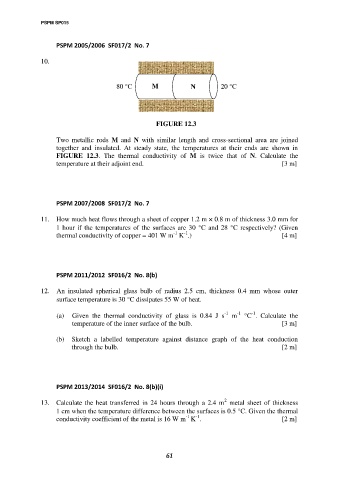
80 C M N 20 C
FIGURE 12.3
Two metallic rods M and N with similar length and cross-sectional area are joined
together and insulated. At steady state, the temperatures at their ends are shown in
FIGURE 12.3. The thermal conductivity of M is twice that of N. Calculate the
temperature at their adjoint end. [3 m]
PSPM 2007/2008 SF017/2 No. 7
11. How much heat flows through a sheet of copper 1.2 m × 0.8 m of thickness 3.0 mm for
1 hour if the temperatures of the surfaces are 30 C and 28 C respectively? (Given
-1
-1
thermal conductivity of copper = 401 W m K .) [4 m]
PSPM 2011/2012 SF016/2 No. 8(b)
12. An insulated spherical glass bulb of radius 2.5 cm, thickness 0.4 mm whose outer
surface temperature is 30 C dissipates 55 W of heat.
-1
-1
-1
(a) Given the thermal conductivity of glass is 0.84 J s m C . Calculate the
temperature of the inner surface of the bulb. [3 m]
(b) Sketch a labelled temperature against distance graph of the heat conduction
through the bulb. [2 m]
PSPM 2013/2014 SF016/2 No. 8(b)(i)
2
13. Calculate the heat transferred in 24 hours through a 2.4 m metal sheet of thickness
1 cm when the temperature difference between the surfaces is 0.5 C. Given the thermal
-1
-1
conductivity coefficient of the metal is 16 W m K . [2 m]
61

