


Page 105 - Programming With Python 3
P. 105
An Introduction to STEM Programming with Python — 2019-09-03a                               Page 92
            Chapter 7 — In, If, Random, and While

             33|  print(g)
             34|  if g >= .9:
             Free
             35|      print ("A")
             36|  elif g >= .75:
             37|      print("B")
             38|  elif g >= .25:
             39|      print("C")
             40|  elif g >= .10:
             eBook
             41|      print("D")
             42|  else:
             43|      print("F")


             Edition
            Trapping Errors


            Sometimes a program causes an error while it is running (usually the result of something that the
            human user has done. We catch errors with the try statement. There are many different ways to use it,
            but in this introduction we will keep the examples simple.
            Please support this work at


             try:
                 suite
             except:              http://syw2l.org
                 suite                                                                             Statement
             The try/except statements will catch an error in a suite of code and pass
                                                                               Free
             control to a special suite to handle the exception.

             https://docs.python.org/3/reference/compound_stmts.html#the-try-statement
             http://bit.ly/2RCXOkO


                                                                   eBook

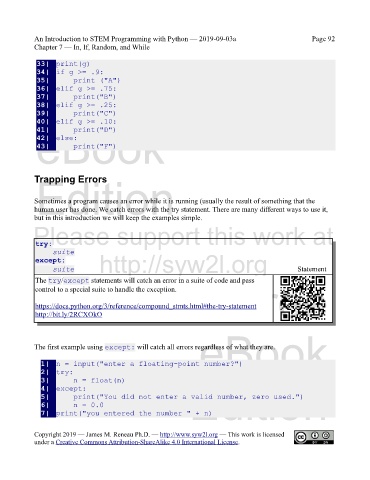
            The first example using except: will catch all errors regardless of what they are.

               1|  n = input("enter a floating-point number?")
               2|  try:
               3|      n = float(n)
                                                                Edition
               4|  except:
               5|      print("You did not enter a valid number, zero used.")
               6|      n = 0.0
               7|  print("you entered the number " + n)


            Copyright 2019 — James M. Reneau Ph.D. — http://www.syw2l.org — This work is licensed
            under a Creative Commons Attribution-ShareAlike 4.0 International License.

