


Page 106 - Programming With Python 3
P. 106
An Introduction to STEM Programming with Python — 2019-09-03a                               Page 93
            Chapter 7 — In, If, Random, and While


            Sometimes you may want to trap an error (keep it from terminating your program) but there is nothing
             Free
            special to be done for the error. You MUST have an except block but you may use the statement pass
            to tell Python that there is nothing to do here.


            What Error was Thrown

             eBook
            You can add an optional Exception as variable after the except statement. This will set the specified
            variable to an object that contains details about the specific exception that was thrown.


            try:
                a = int(input('Enter an integer?'))
                print('the reciprocal of', a , 'is', 1/a )
             Edition
            except Exception as e:
                print("exception of type",type(e), "with message", e)


            Enter an integer?seven
            exception of type <class 'ValueError'> with message invalid literal
            for int() with base 10: 'seven'
            Please support this work at


            Trapping Specific Errors
                                  http://syw2l.org
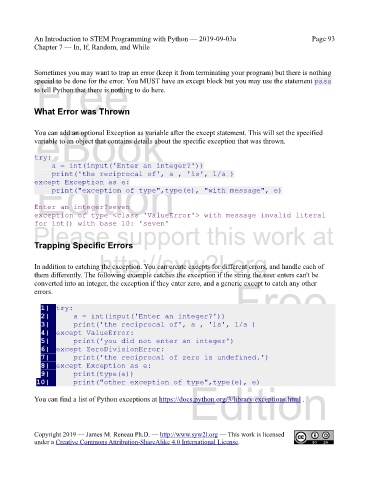
            In addition to catching the exception. You can create excepts for different errors, and handle each of
            them differently. The following example catches the exception if the string the user enters can't be
            converted into an integer, the exception if they enter zero, and a generic except to catch any other
            errors.                                                            Free


               1|  try:
               2|      a = int(input('Enter an integer?'))
               3|      print('the reciprocal of', a , 'is', 1/a )
               4|  except ValueError:
               5|      print('you did not enter an integer')
               6|  except ZeroDivisionError:                       eBook
               7|      print('the reciprocal of zero is undefined.')
               8|  except Exception as e:
               9|      print(type(e))
             10|      print("other exception of type",type(e), e)
                                                                Edition

            You can find a list of Python exceptions at https://docs.python.org/3/library/exceptions.html .


            Copyright 2019 — James M. Reneau Ph.D. — http://www.syw2l.org — This work is licensed
            under a Creative Commons Attribution-ShareAlike 4.0 International License.

