


Page 115 - Programming With Python 3
P. 115
An Introduction to STEM Programming with Python — 2019-09-03a                              Page 102
            Chapter 8— Reuse of Code

               9|      for t in range(5):
             10|          c = coin()
             Free
             11|          print(c)
             12|
             13|  main()


                    head
                    head
             eBook
                    tail
                    head
                    head


            The returned value from a def may be any type of value (integer, float, string, list,…) and may be
            stored into a variable or used directly.
             Edition


             return
             return expression                                                                     Statement
             The return statement is used to terminate the function and return control to the
            Please support this work at
             code that called the function. An expression may be returned from the function, if
             the function call was used in an expression the returned value will be used.

             https://docs.python.org/3/reference/compound_stmts.html#index-13
                                  http://syw2l.org


                                                                               Free
            Passing Values to a Function


            Functions become even more powerful when we can send values to them to use. These values are
            passed to a special type of variables called "free variables".   The free variables are defined in the def
                                                                     6
            statement and are bound to the value where the function was called.
                                                                   eBook
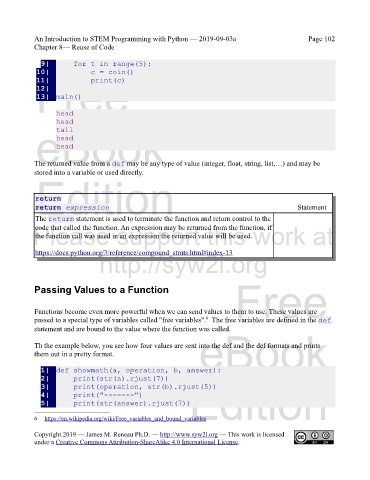
            Th the example below, you see how four values are sent into the def and the def formats and prints
            them out in a pretty format.


               1|  def showmath(a, operation, b, answer):
               2|      print(str(a).rjust(7))
               3|      print(operation, str(b).rjust(5))
               4|      print("-------")
               5|      print(str(answer).rjust(7))              Edition


            6     https://en.wikipedia.org/wiki/Free_variables_and_bound_variables

            Copyright 2019 — James M. Reneau Ph.D. — http://www.syw2l.org — This work is licensed
            under a Creative Commons Attribution-ShareAlike 4.0 International License.

