


Page 117 - Programming With Python 3
P. 117
An Introduction to STEM Programming with Python — 2019-09-03a                              Page 104
            Chapter 8— Reuse of Code

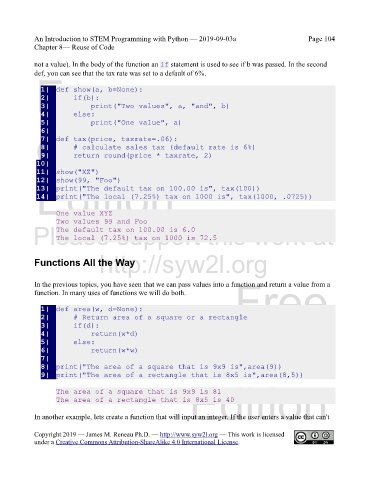
            not a value). In the body of the function an if statement is used to see if b was passed. In the second
            def, you can see that the tax rate was set to a default of 6%.
             Free

               1|  def show(a, b=None):
               2|      if(b):
               3|          print("Two values", a, "and", b)
               4|      else:
               5|          print("One value", a)
             eBook
               6|
               7|  def tax(price, taxrate=.06):
               8|      # calculate sales tax (default rate is 6%)
               9|      return round(price * taxrate, 2)
             10|
             11|  show("XZ")
             Edition
             12|  show(99, "Foo")
             13|  print("The default tax on 100.00 is", tax(100))
             14|  print("The local (7.25%) tax on 1000 is", tax(1000, .0725))

                    One value XYZ
                    Two values 99 and Foo
            Please support this work at
                    The default tax on 100.00 is 6.0
                    The local (7.25%) tax on 1000 is 72.5


                                  http://syw2l.org
            Functions All the Way


            In the previous topics, you have seen that we can pass values into a function and return a value from a
            function. In many uses of functions we will do both.               Free

               1|  def area(w, d=None):
               2|      # Return area of a square or a rectangle
               3|      if(d):
               4|          return(w*d)
               5|      else:
               6|          return(w*w)                             eBook
               7|
               8|  print("The area of a square that is 9x9 is",area(9))
               9|  print("The area of a rectangle that is 8x5 is",area(8,5))
                                                                Edition
                    The area of a square that is 9x9 is 81
                    The area of a rectangle that is 8x5 is 40

            In another example, lets create a function that will input an integer. If the user enters a value that can't


            Copyright 2019 — James M. Reneau Ph.D. — http://www.syw2l.org — This work is licensed
            under a Creative Commons Attribution-ShareAlike 4.0 International License.

