


Page 149 - Programming With Python 3
P. 149
An Introduction to STEM Programming with Python — 2019-09-03a                              Page 136
            Chapter 11 — Date and Time


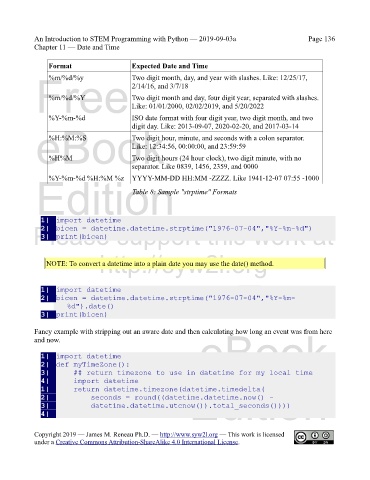
                 Format                      Expected Date and Time
             Free
                                             Two digit month, day, and year with slashes. Like: 12/25/17,
                 %m/%d/%y
                                             2/14/16, and 3/7/18
                 %m/%d/%Y
                                             Two digit month and day, four digit year, separated with slashes.


                                             ISO date format with four digit year, two digit month, and two
                 %Y-%m-%d                    Like: 01/01/2000, 02/02/2019, and 5/20/2022
             eBook
                                             digit day. Like: 2013-09-07, 2020-02-20, and 2017-03-14
                                             Two digit hour, minute, and seconds with a colon separator.
                 %H:%M:%S
                                             Like: 12:34:56, 00:00:00, and 23:59:59
                                             Two digit hours (24 hour clock), two digit minute, with no
                 %H%M
                                             separator. Like 0839, 1456, 2359, and 0000
             Edition
                 %Y-%m-%d %H:%M %z
                                             YYYY-MM-DD HH:MM -ZZZZ. Like 1941-12-07 07:55 -1000
                                             Table 8: Sample "strptime" Formats


               1|  import datetime
            Please support this work at
               2|  bicen = datetime.datetime.strptime("1976-07-04","%Y-%m-%d")
               3|  print(bicen)


                                  http://syw2l.org
                NOTE: To convert a datetime into a plain date you may use the date() method.

                                                                               Free
               1|  import datetime
               2|  bicen = datetime.datetime.strptime("1976-07-04","%Y-%m-
                       %d").date()
               3|  print(bicen)


            Fancy example with stripping out an aware date and then calculating how long an event was from here
            and now.


               1|  import datetime                                 eBook
               2|  def myTimeZone():
               3|      ## return timezone to use in datetime for my local time
               4|      import datetime
                                                                Edition
               1|      return datetime.timezone(datetime.timedelta(
               2|          seconds = round((datetime.datetime.now() -
               3|          datetime.datetime.utcnow()).total_seconds())))
               4|


            Copyright 2019 — James M. Reneau Ph.D. — http://www.syw2l.org — This work is licensed
            under a Creative Commons Attribution-ShareAlike 4.0 International License.

