


Page 157 - Programming With Python 3
P. 157
An Introduction to STEM Programming with Python — 2019-09-03a                              Page 144
            Chapter 12 — String Encoding

               2|  b = bytes("abc            XYZ",'UTF_8')
               3|  print(b)
             Free
               4|  c = b'abc \xf0\x9f\x98\x85 XYZ'
               5|  print(str(c,'UTF_8'))
               6|  a = b'an ASCII string with Unicode \xE2\x80\x9Cquotes\xE2\x80\
                       x9D.'
               7|  print(str(a,"utf_8"))

             eBook
                    b'abc \xf0\x9f\x98\x85 XYZ'
                    abc
                              XYZ
                    an ASCII string with Unicode “quotes”.


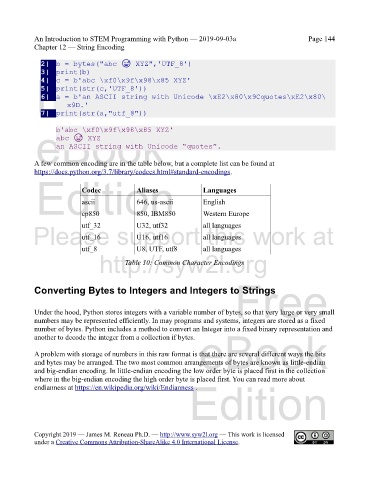
            A few common encoding are in the table below, but a complete list can be found at
            https://docs.python.org/3.7/library/codecs.html#standard-encodings.
             Edition                                                Languages
                                              Aliases
                            Codec
                                              646, us-ascii
                                                                    English
                            ascii
                                              850, IBM850
                            cp850
                                                                    Western Europe
                                                                    all languages
                                              U32, utf32
                            utf_32
            Please support this work at
                                                                    all languages
                                              U16, utf16
                            utf_16
                            utf_8             U8, UTF, utf8         all languages
                                  http://syw2l.org
                                          Table 10: Common Character Encodings
                                                                               Free
            Converting Bytes to Integers and Integers to Strings


            Under the hood, Python stores integers with a variable number of bytes, so that very large or very small
            numbers may be represented efficiently. In may programs and systems, integers are stored as a fixed
            number of bytes. Python includes a method to convert an Integer into a fixed binary representation and
                                                                   eBook
            another to decode the integer from a collection if bytes.

            A problem with storage of numbers in this raw format is that there are several different ways the bits
            and bytes may be arranged. The two most common arrangements of bytes are known as little-endian
            and big-endian encoding. In little-endian encoding the low order byte is placed first in the collection
            where in the big-endian encoding the high order byte is placed first. You can read more about
                                                                Edition
            endianness at https://en.wikipedia.org/wiki/Endianness .


            Copyright 2019 — James M. Reneau Ph.D. — http://www.syw2l.org — This work is licensed
            under a Creative Commons Attribution-ShareAlike 4.0 International License.

