


Page 16 - Programming With Python 3
P. 16
An Introduction to STEM Programming with Python — 2019-09-03a                                Page 3
            Chapter 1 — Python — Arithmetic, Numbers, and Variables

            Chapter 1 — Python — Arithmetic, Numbers, and

             Free
                 Variables


            Introduction


             eBook
            This introductory Chapter will get you started with your first programs in Python. It will introduce the
            two must common types of numbers (integer, and floating-point), operations with numbers, strings, and
            variables.


            Objectives

             Edition
            Upon completion of this chapter's exercises, you should be able to:
                •
                    Use the print statement to display one or more values.
                •
                    Explain the difference between floating-point and integer values.
                • •  Set up mathematical expressions in Python.
                    Produce output using string literals.
            Please support this work at
                •
                    Create variables and assign the results of an expression to them.
                •
                    Use variables in expressions and display the values of variables.
                                  http://syw2l.org
            Prerequisites


            This chapter requires no previous material. It is recommended that Bonus Chapter 1 and Bonus Chapter
            2 be considered before tackling the concept of algorithmic thinking. Free


            The Print Statement with Literals


                                                                   eBook
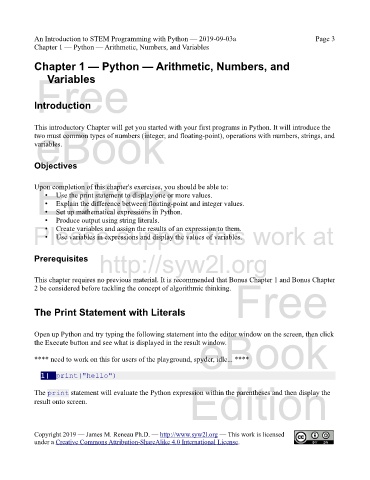
            Open up Python and try typing the following statement into the editor window on the screen, then click
            the Execute button and see what is displayed in the result window.

            **** need to work on this for users of the playground, spyder, idle... ****


               1|  print("hello")
                                                                Edition
            The print statement will evaluate the Python expression within the parentheses and then display the
            result onto screen.


            Copyright 2019 — James M. Reneau Ph.D. — http://www.syw2l.org — This work is licensed
            under a Creative Commons Attribution-ShareAlike 4.0 International License.

