


Page 17 - Programming With Python 3
P. 17
An Introduction to STEM Programming with Python — 2019-09-03a                                Page 4
            Chapter 1 — Python — Arithmetic, Numbers, and Variables


             print(expression)                                                                     Statement
             Free
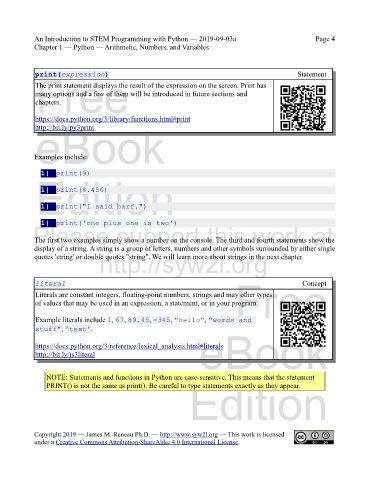
             The print statement displays the result of the expression on the screen. Print has
             many options and a few of them will be introduced in future sections and
             chapters.


             https://docs.python.org/3/library/functions.html#print
             eBook
             http://bit.ly/py3print


            Examples include:

               1|  print(9)
             Edition
               1|  print(8.456)


               1|  print("I said barf.")

               1|  print('one plus one is two')
            Please support this work at

            The first two examples simply show a number on the console. The third and fourth statements show the
            display of a string. A string is a group of letters, numbers and other symbols surrounded by either single
                                  http://syw2l.org
            quotes 'string' or double quotes "string". We will learn more about strings in the next chapter.


                                                                               Free
             literal                                                                                 Concept
             Literals are constant integers, floating-point numbers, strings and may other types
             of values that may be used in an expression, a statement, or in your program.

             Example literals include 1, 67, 89.45, -345, "hello", "words and
             stuff", 'text'.
                                                                   eBook
             https://docs.python.org/3/reference/lexical_analysis.html#literals
             http://bit.ly/js3literal


                NOTE: Statements and functions in Python are case-sensitive. This means that the statement
                                                                Edition
                PRINT() is not the same as print(). Be careful to type statements exactly as they appear.


            Copyright 2019 — James M. Reneau Ph.D. — http://www.syw2l.org — This work is licensed
            under a Creative Commons Attribution-ShareAlike 4.0 International License.

