


Page 32 - Programming With Python 3
P. 32
An Introduction to STEM Programming with Python — 2019-09-03a                               Page 19
            Chapter 2 — Numbering Systems


                                                  Power of 2       Decimal
             Free                                 2 1 2 3                2
                                                   0
                                                                         1
                                                  2
                                                                         4
                                                  2
                                                                         8
                                                  2
                                                   4
                                                  2
             eBook                                                      16
                                                                        32
                                                  2
                                                   5
                                                   6
                                                  2
                                                                        64
                                                  2
                                                   7
                                                                       128
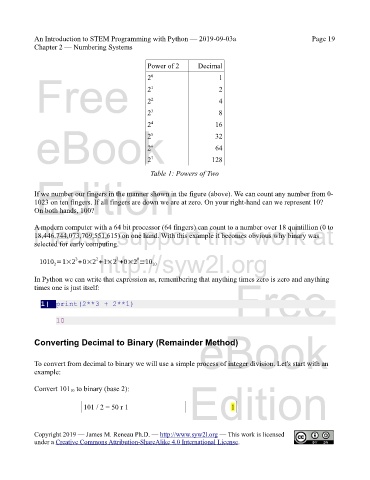
                                                   Table 1: Powers of Two
             Edition
            If we number our fingers in the manner shown in the figure (above). We can count any number from 0-
            1023 on ten fingers. If all fingers are down we are at zero. On your right-hand can we represent 10?
            On both hands, 100?

            Please support this work at
            A modern computer with a 64 bit processor (64 fingers) can count to a number over 18 quintillion (0 to
            18,446,744,073,709,551,615) on one hand. With this example it becomes obvious why binary was
            selected for early computing.
                                  http://syw2l.org
                                 2
                          3
                                              0
                                        1
              1010 =1×2 +0×2 +1×2 +0×2 ≡10         10
                   2
            In Python we can write that expression as, remembering that anything times zero is zero and anything
            times one is just itself:
               1|  print(2**3 + 2**1)                                          Free

                    10

                                                                   eBook
            Converting Decimal to Binary (Remainder Method)


            To convert from decimal to binary we will use a simple process of integer division. Let's start with an
            example:
                                                                Edition
            Convert 101 10 to binary (base 2):


                             101 / 2 = 50 r 1                                1


            Copyright 2019 — James M. Reneau Ph.D. — http://www.syw2l.org — This work is licensed
            under a Creative Commons Attribution-ShareAlike 4.0 International License.

