


Page 98 - Programming With Python 3
P. 98
An Introduction to STEM Programming with Python — 2019-09-03a                               Page 85
            Chapter 7 — In, If, Random, and While


             Free
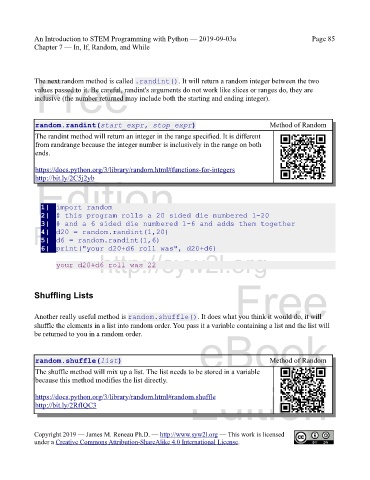
            The next random method is called .randint(). It will return a random integer between the two
            values passed to it. Be careful, randint's arguments do not work like slices or ranges do, they are
            inclusive (the number returned may include both the starting and ending integer).


             random.randint(start_expr, stop_expr)                                        Method of Random
             eBook
             The randint method will return an integer in the range specified. It is different
             from randrange because the integer number is inclusively in the range on both
             ends.

             https://docs.python.org/3/library/random.html#functions-for-integers
             Edition
             http://bit.ly/2C5j2yb


               1|  import random
               2|  # this program rolls a 20 sided die numbered 1-20
               3|  # and a 6 sided die numbered 1-6 and adds them together
            Please support this work at
               4|  d20 = random.randint(1,20)
               5|  d6 = random.randint(1,6)
               6|  print("your d20+d6 roll was", d20+d6)
                                  http://syw2l.org
                    your d20+d6 roll was 22

                                                                               Free

            Shuffling Lists


            Another really useful method is random.shuffle(). It does what you think it would do, it will
            shuffle the elements in a list into random order. You pass it a variable containing a list and the list will
                                                                   eBook
            be returned to you in a random order.


             random.shuffle(list)                                                         Method of Random
             The shuffle method will mix up a list. The list needs to be stored in a variable
             because this method modifies the list directly.
                                                                Edition
             https://docs.python.org/3/library/random.html#random.shuffle
             http://bit.ly/2RfIQC3


            Copyright 2019 — James M. Reneau Ph.D. — http://www.syw2l.org — This work is licensed
            under a Creative Commons Attribution-ShareAlike 4.0 International License.

