


Page 99 - Programming With Python 3
P. 99
An Introduction to STEM Programming with Python — 2019-09-03a                               Page 86
            Chapter 7 — In, If, Random, and While


             Free
               1|  import random
               2|  kids = ["bob","june","sam","alex","pat","gab"]
               3|  random.shuffle(kids)
               4|  print("team 1 is", kids[0:3])
               5|  print("team 2 is", kids[3:])
             eBook
                    team 1 is ['gab', 'bob', 'sam']
                    team 2 is ['alex', 'june', 'pat']


            Selection with If


             Edition
            Now that we have covered Boolean operators, comparisons, the in operator, and random numbers; it is
            time to put them all to use. We call statements that conditionally execute code, based on a value, the
                                3
            process of selection.   In Python the if statement is the main selection structure. 4

            If
            Please support this work at


            The if statement is the simplest of the Python selection statements. It will allow for conditional
            execution of a single block of code. If the expression is not false (true) then the suite (indented code)
            will be executed.     http://syw2l.org


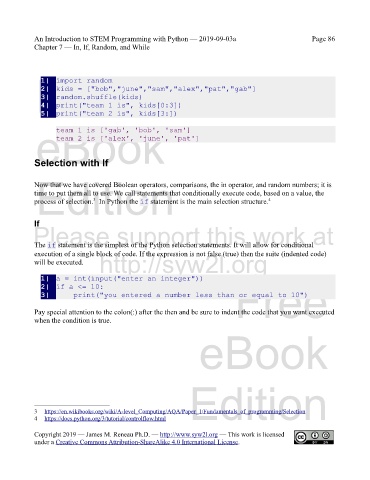
               1|  a = int(input("enter an integer"))
                                                                               Free
               2|  if a <= 10:
               3|      print("you entered a number less than or equal to 10")


            Pay special attention to the colon(:) after the then and be sure to indent the code that you want executed
            when the condition is true.

                                                                   eBook


                                                                Edition


            3   https://en.wikibooks.org/wiki/A-level_Computing/AQA/Paper_1/Fundamentals_of_programming/Selection


            4   https://docs.python.org/3/tutorial/controlflow.html
            Copyright 2019 — James M. Reneau Ph.D. — http://www.syw2l.org — This work is licensed
            under a Creative Commons Attribution-ShareAlike 4.0 International License.

