


Page 47 - T-I JOURNAL19-3
P. 47
ARGUS SYSTEM                                 607


               Argus I was the first-generation epiretinal pros-  NCT00407602). They ranged from 28 to 77 years old,
             thesis approved for an investigational clinical trial  and all had little to no light perception in both eyes.
             by the FDA. The Argus I had a microarray of 16  Twenty-nine patients had a diagnosis of RP, and one
             electrodes in a 4 x 4 arrangement (Figure 3) and was  was diagnosed with choroideremia. Among these
             implanted by one of us (MSH) in six subjects blinded  30 devices, 29 remain implanted and functional to
             by RP. All subjects perceived light when the device  date, while only one was explanted, with the latter
             was activated, and they could perform visual spatial  being due to recurrent conjunctival erosion rather
             and motion tasks after a short period of training.  than device failure. All subjects were able to perceive
             The long term safety and effectiveness of Argus I  light during electrical stimulation. Serious adverse
             was observed, and ophthalmic images showed a sta-  events (SAEs) were reported in 11 patients during
             ble physical retina-implant interface after long-term   the first three years and in only one patient between
             stimulation up to a decade despite the formation of   years three and five. The most common SAEs were
             some fibrotic tissues around the tack in the early   hypotony, conjunctival dehiscence, erosion over the
             months after the surgery (17). The results of Argus   extraocular portion of the implant, and presumable
             I motivated the development of the more advanced   endophthalmitis (culture negative). Most SAEs (61%)
             Argus II system.                           occurred within six months of implantation, and
                                                        three patients accounted for over 55% of SAEs at year
                                                        three. Two patients needed retacking of the array to
                                                        the retina one week after implantation (20).


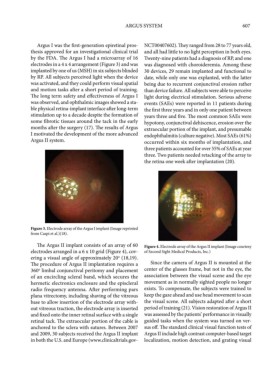
             Figure 3. Electrode array of the Argus I implant (Image reprinted
             from Caspi et al.)(18).
               The Argus II implant consists of an array of 60   Figure 4. Electrode array of the Argus II implant (Image courtesy
             electrodes arranged in a 6 x 10 grid (Figure 4), cov-  of Second Sight Medical Products, Inc.)
             ering a visual angle of approximately 20  (18,19).
                                              o
             The procedure of Argus II implantation requires a     Since the camera of Argus II is mounted at the
             360  limbal conjunctival peritomy and placement   center of the glasses frame, but not in the eye, the
               o
             of an encircling scleral band, which secures the   association between the visual scene and the eye
             hermetic electronics enclosure and the episcleral   movement as in normally sighted people no longer
             radio frequency antenna. After performing pars  exists. To compensate, the subjects were trained to
             plana vitrectomy, including shaving of the vitreous  keep the gaze ahead and use head movement to scan
             base to allow insertion of the electrode array with-  the visual scene. All subjects adapted after a short
             out vitreous traction, the electrode array is inserted  period of training (21). Vision restoration of Argus II
             and fixed onto the inner retinal surface with a single  was assessed by the patients’ performance in visually
             retinal tack. The extraocular portion of the cable is  guided tasks when the system was turned on ver-
             anchored to the sclera with sutures. Between 2007  sus off. The standard clinical visual function tests of
             and 2009, 30 subjects received the Argus II implant  Argus II include high contrast computer-based target
             in both the U.S. and Europe (www.clinicaltrials.gov-  localization, motion detection, and grating visual

