


Page 46 - T-I JOURNAL19-3
P. 46
606                                    LIN ET AL.


      a multi-electrode array placed adjacent to the ret-  the diffused and/or distorted visual percepts due to
      ina to elicit visual percepts that the field of retinal  undesired activation of the axons of passage (7). As
      prostheses started to advance rapidly (7). Different  an epiretinal implant, both Argus I and II require
      retinal prostheses products and prototypes have  surgical fixation of an electrode array to the retinal
      since been developed and tested in humans, among  surface with a retinal tack. The array is designed
      which two devices have received regulatory approval  to conform to the curvature of the inner retina to
      for clinical use. Argus II epiretinal implant (Second  maintain a consistent distance between the electrodes
      Sight Medical Products, Sylmar, California) received  and the retina for optimized stimulation.
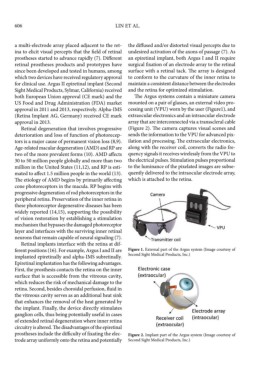
      both European Union approval (CE mark) and the    The Argus systems contain a miniature camera
      US Food and Drug Administration (FDA) market  mounted on a pair of glasses, an external video pro-
      approval in 2011 and 2013, respectively. Alpha-IMS  cessing unit (VPU) worn by the user (Figure1), and
      (Retina Implant AG, Germany) received CE mark  extraocular electronics and an intraocular electrode
      approval in 2013.                           array that are interconnected via a transscleral cable
        Retinal degeneration that involves progressive   (Figure 2). The camera captures visual scenes and
      deterioration and loss of function of photorecep-  sends the information to the VPU for advanced pix-
      tors is a major cause of permanent vision loss (8,9).  ilation and processing. The extraocular electronics,
      Age-related macular degeneration (AMD) and RP are  along with the receiver coil, converts the radio fre-
      two of the more prevalent forms (10). AMD affects  quency signals it receives wirelessly from the VPU to
      30 to 50 million people globally and more than two  the electrical pulses. Stimulation pulses proportional
      million in the United States (11,12), and RP is esti-  to the luminance of the pixelated images are subse-
      mated to affect 1.5 million people in the world (13).  quently delivered to the intraocular electrode array,
      The etiology of AMD begins by primarily affecting  which is attached to the retina.
      cone photoreceptors in the macula. RP begins with
      progressive degeneration of rod photoreceptors in the
      peripheral retina. Preservation of the inner retina in
      these photoreceptor degenerative diseases has been
      widely reported (14,15), supporting the possibility
      of vision restoration by establishing a stimulation
      mechanism that bypasses the damaged photoreceptor
      layer and interfaces with the surviving inner retinal
      neurons that remain capable of neural signaling (7).
        Retinal implants interface with the retina at dif-
      ferent positions (16). For example, Argus I and II are   Figure 1. External part of the Argus system (Image courtesy of
      implanted epiretinally and alpha-IMS subretinally.   Second Sight Medical Products, Inc.)
      Epiretinal implantation has the following advantages.
      First, the prosthesis contacts the retina on the inner
      surface that is accessible from the vitreous cavity,
      which reduces the risk of mechanical damage to the
      retina. Second, besides choroidal perfusion, fluid in
      the vitreous cavity serves as an additional heat sink
      that enhances the removal of the heat generated by
      the implant. Finally, the device directly stimulates
      ganglion cells, thus being potentially useful in cases
      of extended retinal degeneration where inner retina
      circuitry is altered. The disadvantages of the epiretinal
      prostheses include the difficulty of fixating the elec-  Figure 2. Implant part of the Argus system (Image courtesy of
      trode array uniformly onto the retina and potentially   Second Sight Medical Products, Inc.)

