


Page 55 - T-I JOURNAL19-3
P. 55
614   XIE ET AL.               IONO-ELASTOMERS FOR WEARABLE ELECTRONICS                     615


   Motion capture, especially, can be commonly   sensitive strain sensors (10,18,25). For example, a   related classes of block copolymers and ionic liquids  breaks at 3000% elongation and has an ultimate ten-
 found in surveillance, military, entertainment,  recently reported carbon nanotube–silicone rubber   can be used to tune the iono-elastomer’s physical  sile strength of 200 MPa (36). Compared to a regular
 sports, and medical applications (14,15). Conven-  based strain sensor can be stretched to maximum   and chemical properties. The variety and variability  rubber band shown in Figure 4 (b), our iono-elas-
 tional human motion capture is primarily based on  strain of 500% with a good reversible response (26).   of raw materials will not only cultivate diversity in  tomer has about one order of magnitude higher
 optical systems, inertial sensors, magnetic systems,    Herein, we describe the invention of a simpli-  our product and prototype invention but also lead  extensibility. Remarkably, the conductivity of our
 or mechanical systems. Optical systems, which are  fied two-step manufacturing process to create   to manifold commercialization streams.   iono-elastomer increases with extension (36), which
 intensively studied and widely used, typically come  ultra-stretchable materials with tunable conductivity     Utilizing the selected raw materials, we have suc-  is a response opposite to that of most conductive
 in two categories: systems with markers and sys-  that are particularly applicable for wearable elec-  cessfully demonstrated a simplified manufacturing  materials, such as the calculation for the comparable
 tems without markers. Marker systems require very  tronics and associated technologies. At the heart of   process to create stretchable conductive materials  extension of a copper wire, as shown in Figure 5 (a).
 complex equipment, a special environment, and are  the fabrication of this novel iono-elastomer is the   applicable for stretchable electronic technologies  This is a unique and non-trivial material response
 financially and spatiotemporally expensive. Mark-  nanoscale hierarchical self-assembly of function-  by self-assembly of concentrated solutions of the  because, for instance, the electrical resistance of a
 erless systems, while more convenient and more  alized, commercially available polymers in a protic   end-functionalized, commercially available, and inex-  constant volume copper wire increases as it is (irre-
 broadly applicable, have many drawbacks, such as  ionic liquid, followed by chemical crosslinking. The   pensive triblock copolymer Pluronic F127 in the  versibly) extended into longer and thinner wire (as
 requiring further digital processing using complex  invention uses this novel iono-elastomer to cre-  protic ionic liquid EAN followed by micelle corona  depicted in Figure 5 (b)). The calculated, normal-
 algorithms, sensitivity to the environment of use, and  ate a transparent, lightweight, customizable, and   crosslinking to generate elastomeric ion gels, termed  ized electrical resistance as a function of elongation
 generally not being as accurate as marker systems.  skin-mountable strain sensor patch. The potential   “iono-elastomers.”(35, 36) The chemical structures of  strain is also plotted on Figure 5 (a), which shows
 A review of these and other prevalent methods pro-  for commercialization, including market size and   Pluronic F127 and EAN are presented in Figure 2 (a)  the opposite response of our iono-elastomer. This
 vides an overview of the advantages and drawbacks  competitive landscape, and potential benefits to soci-  and (b), and a schematic of the synthesis and fabrica-  novel mechano-electrical material property plays a
 of the current methods (16). Improvements that can  ety of this invention are presented and discussed.   tion of the Pluronic F127 diacrylate iono-elastomer  significant role in strain sensor device design because,
 reduce cost, shrink the size and/or volume of the   is shown in Figure 2 (c), (d), and (e). As shown in  as resistance decreases under extension, the device
 device, and minimize the influence on performers  Description of Ultra-Stretchable Conductive   Figure 2 (e), the resulting material is an optically clear,  is anticipated to require less energy, thus increasing
 while maintaining accuracy are highly desired. As  Iono-Elastomer Invention  free-standing elastomer, which is our “iono-elas-  battery life. The origin of this novel electromechanical
 body motion can often involve relatively large strains    The raw materials were downselected to create a   tomer.” This particular iono-elastomer exhibits an  response is the complex  microstructural rearrange-
 (≥55%) (17,18), a possible solution is the creation of  highly stretchable, conductive material that could   unprecedented combination of high stretchability,  ment of the hierarchically assembled micelles under
 new wearable, flexible, and highly extensible strain  spontaneously self-assemble at the nanoscale to form   tunable ionic conductivity, and mechano-electrical  uniaxial extension (36). To summarize, this stress-in-
 sensors.   a hierarchically-microstructured iono-elastomer. A   response (36).   duced microstructural rearrangement (depicted in
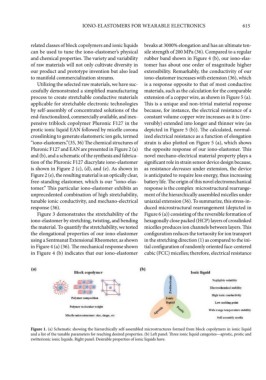
   The design criteria for high-performance wearable,  commercial triblock copolymer (Pluronic F127)     Figure 3 demonstrates the stretchability of the  Figure 6 (a)) consisting of the reversible formation of
 flexible, and stretchable strain sensors includes high  (27), which is a macromolecule with linear and/or   iono-elastomer by stretching, twisting, and bending  hexagonally close packed (HCP) layers of crosslinked
 sensitivity (i.e., large gauge factor (GF) for measur-  radial arrangements of two or more different blocks   the material. To quantify the stretchability, we tested  micelles produces ion channels between layers. This
 ing small human motions), high flexibility and high  of varying monomer compositions, was selected for   the elongational properties of our iono-elastomer  configuration reduces the tortuosity for ion transport
 extensibility (capable of accommodating elongational  the mechanical building block (28). Block copoly-  using a Sentmanat Extensional Rheometer, as shown  in the stretching direction (1) as compared to the ini-
 strains of ≥55%), good stability (capable of measuring  mers can impart mechanical strength to the system   in Figure 4 (a) (36). The mechanical response shown  tial configuration of randomly oriented face-centered
 repetitive deformations with low hysteresis), and fast  via self-assembly in suitable self-assembly media, as   in Figure 4 (b) indicates that our iono-elastomer  cubic (FCC) micelles; therefore, electrical resistance
 response speed (fast signal acquisition). Moreover,  shown in Figure 1 (a) (29). Conductivity is provided
 it is desirable that these devices have a low material  by ethylammonium nitrate (EAN) (30), which is
 and fabrication cost and be technically simple, light-  a room temperature protic ionic liquid. An ionic
 weight, and small, as well as being biocompatible for  liquid is chosen for its remarkable physio-chemical
 skin-mountable applications and comfortable to wear  properties: high ion conductivity (up to 100 mS/cm),
 (19,20). Although conventional strain sensors have  wide electrochemical windows (up to 5.8 V), and high
 advantages in low fabrication cost, they typically  electrochemical and thermal stability (31). Further-
 have poor stretchability and sensitivity (maximum  more, it has negligible vapor pressure, which implies
 strain of 5% and GF ~ 2). Recent advances in creating  that it does not evaporate at any service temperature
 advanced strain sensors have focused on nanoma-  (32,33). Importantly, EAN can also act as an effective
 terials, e.g., graphene (18,21,22), carbon nanotubes  self-assembly media for the block copolymer (34). In
 (17,19,23), nanoparticles (24), and nanowires (8).  addition, both block copolymers and ionic liquids are   Figure 1. (a) Schematic showing the hierarchically self-assembled microstructures formed from block copolymers in ionic liquid
 Among them, carbon nanomaterial-based sensors  two representative classes of “designer compounds,”   and a list of the tunable parameters for reaching desired properties. (b) Left panel: Three ionic liquid categories—aprotic, protic and
 have shown outstanding performance as highly  meaning that specific combinations selected from the   zwitterionic ionic liquids. Right panel: Desirable properties of ionic liquids have.

