


Page 842 - MARSIUM'21 COMP OF PAPER
P. 842
843


            well-organized content will create a good assumption among customers. For instance, a good website reflects that the business is willing to
            invest in providing satisfactory user experience and maintaining relationship which in turn shapes the online business as trustworthy (Tasin,
            2017). In online environment, complementarity comprises of integration and information for businesses to generate and maintain customer’s
            trust (Setiawan et al., 2018). A previous study found that the four attributes of website quality consist of usability, ease of use, entertainment
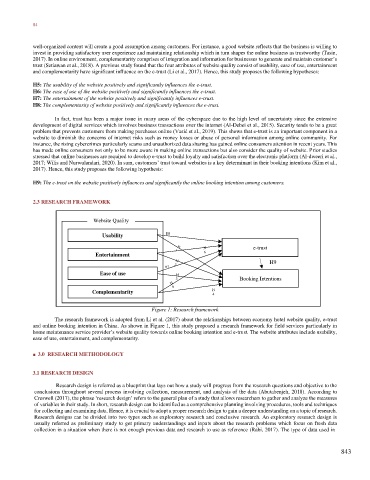
            and complementarity have significant influence on the e-trust (Li et al., 2017). Hence, this study proposes the following hypotheses:

            H5: The usability of the website positively and significantly influences the e-trust.
            H6: The ease of use of the website positively and significantly influences the e-trust.
            H7: The entertainment of the website positively and significantly influences e-trust.
            H8: The complementarity of website positively and significantly influences the e-trust.

                   In fact, trust has been a major issue in many areas of the cyberspace due to the high level of uncertainty since the extensive
            development of digital services which involves business transactions over the internet (Al-Debei et al., 2015). Security tends to be a great
            problem that prevents customers from making purchases online (Vasić et al., 2019). This shows that e-trust is an important component in a
            website to diminish the concerns of internet risks such as money losses or abuse of personal information among online community. For
            instance, the rising cybercrimes particularly scams and unauthorized data sharing has gained online consumers attention in recent years. This
            has made online consumers not only to be more aware in making online transactions but also consider the quality of website. Prior studies
            stressed that online businesses are required to develop e-trust to build loyalty and satisfaction over the electronic platform (Al-dweeri et al.,
            2017; Wilis and Nurwulandari, 2020). In sum, customers’ trust toward websites is a key determinant in their booking intentions (Kim et al.,
            2017). Hence, this study proposes the following hypothesis:

            H9: The e-trust on the website positively influences and significantly the online booking intention among customers.


            2.3 RESEARCH FRAMEWORK


                                Website Quality

                                   Usability            H5

                                 Entertainment                                       e-trust
                                                                                          H9
                                                        H7
                                  Ease of use
                                                                                Booking Intentions

                                Complementarity

                                                   Figure 1: Research framework
                   The research framework is adopted from Li et al. (2017) about the relationships between economy hotel website quality, e-trust
            and online booking intention in China. As shown in Figure 1, this study proposed a research framework for field services particularly in
            home maintenance service provider’s website quality towards online booking intention and e-trust. The website attributes include usability,
            ease of use, entertainment, and complementarity.

            ■  3.0  RESEARCH METHODOLOGY


            3.1 RESEARCH DESIGN

                    Research design is referred as a blueprint that lays out how a study will progress from the research questions and objective to the
            conclusions throughout several process involving collection, measurement, and analysis of the data (Abutabenjeh, 2018). According to
            Creswell (2017), the phrase ‘research design’ refers to the general plan of a study that allows researchers to gather and analyze the measures
            of variables in their study. In short, research design can be identified as a comprehensive planning involving procedures, tools and techniques
            for collecting and examining data. Hence, it is crucial to adopt a proper research design to gain a deeper understanding on a topic of research.
            Research designs can be divided into two types such as exploratory research and conclusive research. An exploratory research design is
            usually referred as preliminary study to get primary understandings and inputs about the research problems which focus on fresh data
            collection in a situation when there is not enough previous data and research to use as reference (Rahi, 2017). The type of data used in


                                                                                                                  843

