


Page 991 - MARSIUM'21 COMP OF PAPER
P. 991
rating, and share the brand’s post. Therefore, it is recommended that businesses must pay attention to social media content to encourage
            customers to interact with posts which in turn reinforce customer brand engagement (Barger et al. 2016). As such, Chop Kek Lian Seng
            should strategize on customer brand engagement.

            2.5 HYPOTHESES DEVELOPMENT

                    Social Media Interaction and Customer Brand Engagement
                   Interactive brand pages motivate the engagement between brand and consumes with a positive perception of the brand (Ismail,
            2017). Brand must provide good content to attract customers to click the button “like” or reply to the message of the brand (Jayasingh, 2015).
            Social media engagement activities such as posting comments and subscribing to the brand page are important to strengthen the interaction
            between brands and consumers (Hanna et al., 2011). For example, Facebook activity is associated with number of posts and the  content
            posted (Jayasingh, 2015). Many studies found that social media is important to boost online interaction and participation that has changed
            the way people communicate with companies and brands (Kietzmann et al., 2011; Hanna et al., 2011; Leung et al., 2017). According to
            Cheung et al. (2020), interaction is the most important social media marketing elements to build up a brand and customer brand engagement.
            In addition, Seo and Park (2018) noted that social media marketing activities help to increase brand awareness and create a powerful brand
            image for organizations to interact with their customers. Moreover, marketer may use Facebook as an important social media to target users
            that have a positive attitude toward a brand (Bitter and Kräuter, 2013) Thus, this study aims to examine the relationship between interaction
            and customer brand engagement, then, the following hypothesis is proposed:

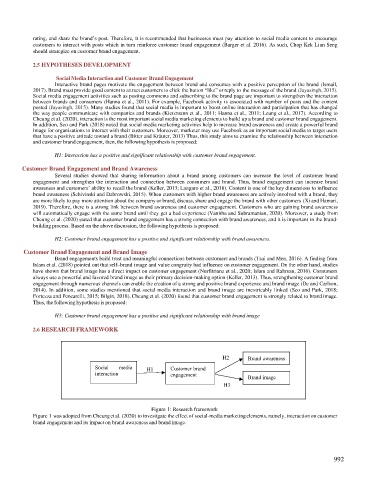
                   H1: Interaction has a positive and significant relationship with customer brand engagement.

        Customer Brand Engagement and Brand Awareness
                   Several  studies  showed  that  sharing  information  about  a  brand  among  customers  can  increase  the  level  of  customer  brand
            engagement  and strengthen the interaction and connection between consumers and brand. Thus, brand engagement  can increase brand
            awareness and customers’ ability to recall the brand (Keller, 2013; Langaro et al., 2018). Content is one of the key dimensions to influence
            brand awareness (Schivinski and Dabrowski, 2015). When customers with higher brand awareness are actively involved with a brand, they
            are more likely to pay more attention about the company or brand, discuss, share and engage the brand with other customers (Xi and Hamari,
            2019). Therefore, there is a strong link between brand awareness and customer engagement. Customers who are gaining brand awareness
            will automatically engage with the same brand until they get a bad experience (Vanitha and Subramanian, 2020). Moreover, a study from
            Cheung et al. (2020) stated that customer brand engagement has a strong connection with brand awareness, and it is important in the brand-
            building process. Based on the above discussion, the following hypothesis is proposed:

                   H2: Customer brand engagement has a positive and significant relationship with brand awareness.

         Customer Brand Engagement and Brand Image
                   Brand engagements build trust and meaningful connections between customers and brands (Tsai and Men, 2016). A finding from
            Islam et al. (2018) pointed out that self–brand image and value congruity had influence on customer engagement. On the other hand, studies
            have shown that brand image has a direct impact on customer engagement (Nurfitriana et al., 2020; Islam and Rahman, 2016). Consumers
            always use a powerful and favored brand image as their primary decision-making option (Keller, 2013). Thus, strengthening customer brand
            engagement through numerous channels can enable the creation of a strong and positive brand experience and brand image (De and Carlson,
            2014). In addition, some studies mentioned that social media interaction and brand image are inextricably linked  (Seo and Park, 2018;
            Fortezza and Pencarelli, 2015; Bilgin, 2018). Cheung et al. (2020) found that customer brand engagement is strongly related to brand image.
            Thus, the following hypothesis is proposed:

                   H3: Customer brand engagement has a positive and significant relationship with brand image

            2.6 RESEARCH FRAMEWORK


                                                                           H2      Brand awareness
                                Social   media    H1     Customer brand
                                interaction              engagement                Brand image
                                                                           H3


                                                   Figure 1: Research framework
            Figure 1 was adopted from Cheung et al. (2020) to investigate the effect of social-media marketing elements, namely, interaction on customer
            brand engagement and its impact on brand awareness and brand image.


                                                                                                                992

