


Page 63 - ssr_16
P. 63
2.2.5 How does the institution identify and respond to the learning needs of
advanced learners?
As mentioned above, individual teachers are attentive to student needs based on their
interaction and they are guided appropriately. Several certificate courses are offered
to students who have the inclination to go beyond the regular classroom curriculum.
They are willing to spend money, time and effort to take up courses of their choice.
The courses include GIS and Remote Sensing, Ecological Sampling Techniques,
Ornithology, Statistics using MS Excel, Connecting People and Plants, Course on R
Software, Data Science Analytics, Accounts, Practice Teaching, Research
Methodology, Life Skills, Gender Studies, Space and Rocket Dynamics,
Spectroscopy, Economic Botany, Environmental Science, Wildlife and Conservation.
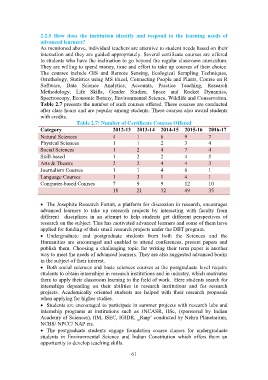
Table 2.7 presents the number of such courses offered. These courses are conducted
after class hours and are popular among students. These courses also award students
with credits.
Table 2.7: Number of Certificate Courses Offered
Category 2012-13 2013-14 2014-15 2015-16 2016-17
Natural Sciences 4 1 6 9 7
Physical Sciences 1 1 2 3 4
Social Sciences 1 2 4 7 4
Skill-based 1 2 2 4 5
Arts & Theatre 2 2 4 4 3
Journalism Courses 1 1 4 6 1
Language Courses 1 3 1 4 1
Computer-based Courses 7 9 9 12 10
18 21 32 49 35
The Josephite Research Forum, a platform for discussion in research, encourages
advanced learners to take up research projects by interacting with faculty from
different disciplines in an attempt to help students get different perspectives of
research on the subject. This has motivated advanced learners and some of them have
applied for funding of their small research projects under the DBT program.
Undergraduate and postgraduate students from both the Sciences and the
Humanities are encouraged and enabled to attend conferences, present papers and
publish them. Choosing a challenging topic for writing their term paper is another
way to meet the needs of advanced learners. They are also suggested advanced books
in the subject of their interest.
Both social sciences and basic sciences courses at the postgraduate level require
students to obtain internships in research institutions and in industry, which motivates
them to apply their classroom learning to the field of work. Here students search for
internships depending on their abilities in research institutions and for research
projects. Academically oriented students are helped with their research proposals
when applying for higher studies.
Students are encouraged to participate in summer projects with research labs and
internship programs at institutions such as JNCASR, IISc, (sponsored by Indian
Academy of Sciences), IIM, ISEC, IGIDR, ‗Reap‘ conducted by Nehru Planetarium,
NCBS/ NPCC/ NAP etc.
The postgraduate students engage foundation course classes for undergraduate
students in Environmental Science and Indian Constitution which offers them an
opportunity to develop teaching skills.
61

