


Page 106 - Account 10
P. 106
i.   Total Method
              In this method, both the debit and credit totals (before balancing the accounts) of the
          ledger accounts are put in the respective debit and credit column. When both the totals
          in the trial balance are equal at the last, it proves the arithmetical accuracy of the books of
          account.
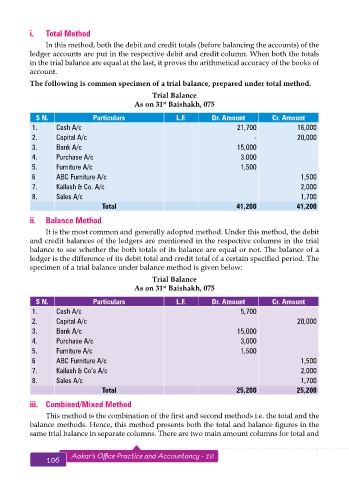
          The following is common specimen of a trial balance, prepared under total method.
                                            Trial Balance
                                       As on 31  Baishakh, 075
                                               st
           S N.            Particulars             L.F.      Dr. Amount       Cr. Amount
          1.     Cash A/c                                           21,700           16,000
          2.     Capital A/c                                             -           20,000
          3.     Bank A/c                                           15,000
          4.     Purchase A/c                                        3.000
          5.     Furniture A/c                                       1,500
          6      ABC Furniture A/c                                                    1,500
          7.     Kailash & Co. A/c                                                    2,000
          8.     Sales A/c                                                            1,700
                              Total                                 41,200           41,200
          ii.  Balance Method
              It is the most common and generally adopted method. Under this method, the debit
         and credit balances of the ledgers are mentioned in the respective columns in the trial
         balance to see whether the both totals of its balance are equal or not. The balance of a
         ledger is the difference of its debit total and credit total of a certain specified period. The
         specimen of a trial balance under balance method is given below:
                                            Trial Balance
                                       As on 31  Baishakh, 075
                                               st
           S N.            Particulars             L.F.      Dr. Amount       Cr. Amount
          1.     Cash A/c                                            5,700
          2.     Capital A/c                                                         20,000
          3.     Bank A/c                                           15,000
          4.     Purchase A/c                                        3,000
          5.     Furniture A/c                                       1,500
          6      ABC Furniture A/c                                                    1,500
          7.     Kailash & Co’s A/c                                                   2,000
          8.     Sales A/c                                                            1,700
                              Total                                 25,200           25,200

          iii.  Combined/Mixed Method
              This method is the combination of the first and second methods i.e. the total and the
          balance methods. Hence, this method presents both the total and balance figures in the
         same trial balance in separate columns. There are two main amount columns for total and


              106    Aakar’s Office Practice and Accountancy - 10                                                                                            Trial Balance            107

