


Page 23 - Account 10
P. 23
iii.  Legal Formality

              There may be a legal obligation to preserve some of the official records for a certain
          time in the future. In such a case, filing fulfils the legal formality by presenting the records
         for  the  future.  Such  records  may  be  agreements  enforceable  by  law,  treaties,  audited
         books of A/c in case of a public company, etc.

          iv   Builds Business Image and Goodwill
              A good filing system helps an organization to build up and boost its image and
          goodwill  in  the  society.  It  enables  the  society  to  make  positive  attitude  towards  the
          organization,  which  results  a  good  social  relation.  A  good  social  relation  leads  an
          organization towards success through their help and cooperation.
          v.  Increases Efficiency
              A good filing system helps in providing the records whenever needed without delay
          and difficulty. It facilitates the smooth performance and prompt replies of inquiries, etc.
          In this way, filing serves in increasing office efficiency by means of regular supply of the
          necessary information to the various units of the organization in time.
          vi.  Providing Information
              Filing  collects  and  preserves  records  and  documents.  It  provides  information  to
          the shareholders, government authorities, debtors, creditors, house owner and others. It
          supplies reports of achievement, activities and information at the time of need with the
         help of collected and preserved documents.
          Vii. Collection of Documents

              The main objectives or importance of filing is to collect documents from difference
          sources. They cannot be preserved without their collection. Hence, collection of letters
          and documents can be regarded as the objective or importance of filing.

                   Points to Remember

            i.  Safeguarding records        ii. Providing Proof for the Future  iii. Legal formality
            iv. Builds business image and goodwill  v. Increases efficiency  vii. Providing information
            vii. Collection of Documents

          3.  Classifications / Methods of Filing
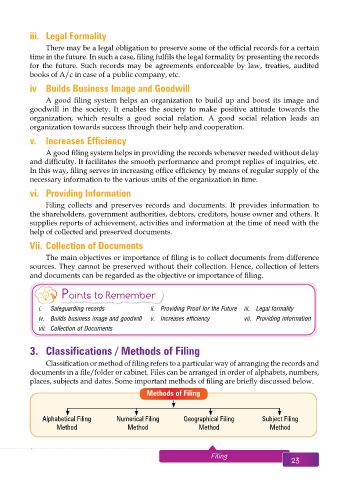
              Classification or method of filing refers to a particular way of arranging the records and
          documents in a file/folder or cabinet. Files can be arranged in order of alphabets, numbers,
          places, subjects and dates. Some important methods of filing are briefly discussed below.
                                           Methods of Filing


             Alphabetical Filing   Numerical Filing   Geographical Filing   Subject Filing
                 Method              Method               Method              Method


 22  Aakar’s Office Practice and Accountancy - 10            Filing                 23

