


Page 63 - Account 10
P. 63
There are different views about the origin of bank. According to one view, the word
          ‘bank’ is derived from the Italian word ‘Banco’ which means a bench. In the early days,
         monetary/banking activities were done by sitting on a bench by Italian goldsmith. Then,
         banco became bank. The first bank called the “Bank of Venice” as established in Venice,
         Italy in 1157 AD. It was established to finance the monarch in his wars. The modern
          commercial banking institutions have been developed after the enactment of Banking Act
          in 1833 AD, which provided freedom for the establishment of commercial banks.
          A  bank  simply  is  a  financial  institution,  which  deals  with  the  monetary  activities  by
          accepting  deposits,  lending  to  the  various  parties  against  securities  and  performing
          agency services to its client/customer.
          According  to  the  Oxford  Advanced  Learner’s  Dictionary,  “The  term  ‘bank’  means  an
          establishment for keeping money and valuables safely, the money being paid out on the customer’s
          order or cheques.”
          Similarly, in the words of Kent, “A bank is an organization whose principal operations are
          concerned with the accumulation of the temporarily idle money of the general public for the purpose
          of advancing to others for expenditure.”
          “Banks are financial institutions that fund in the form of deposit repayable in demand or in short
          notice”. World Bank.
          According to dictionary of Banking and Finance, “Business which holds money for its clients
          which leads money at interest and trades generally in money.”
          In the modern day business world, the scope of bank has
          become so wide that it covers all the financial activities
          from  the  issue  of  money  to  the  performance  of  agency
          services to its clients/customers. In this sense, a bank may
          be  defined  as  a  financial  institution,  which  accepts  the
          deposit for the purpose of lending or investment from the
          public, repayable on demand through cheques, drafts or
          otherwise and also performs a number of agency services
          to its clients on instruction. The central bank of a country
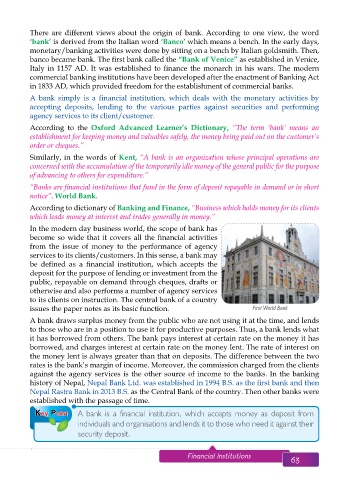
          issues the paper notes as its basic function.                  First World Bank
          A bank draws surplus money from the public who are not using it at the time, and lends
          to those who are in a position to use it for productive purposes. Thus, a bank lends what
          it has borrowed from others. The bank pays interest at certain rate on the money it has
          borrowed, and charges interest at certain rate on the money lent. The rate of interest on
          the money lent is always greater than that on deposits. The difference between the two
          rates is the bank’s margin of income. Moreover, the commission charged from the clients
          against the agency services is the other source of income to the banks. In the banking
          history of Nepal, Nepal Bank Ltd. was established in 1994 B.S. as the first bank and then
          Nepal Rastra Bank in 2013 B.S. as the Central Bank of the country. Then other banks were
          established with the passage of time.

           Key Point   A bank is a financial institution, which  accepts money  as deposit  from
                       individuals and organisations and lends it to those who need it against their
                       security deposit.


 62  Aakar’s Office Practice and Accountancy - 10     Financial Institutions        63

