


Page 65 - Account 10
P. 65
iv.  Commercial banks issue various credit instruments like cheque, bank draft, traveller’s
              cheque, credit cards, letter of credit etc. that assure fast and safe remittance of money
              and personal expenses in a reliable manner.
          v.   Banks provide a number of agency services to their clients/customers, like receipt of
              income and payment of expenses, etc.
          vi.  Banks provide financial, technical and administrative assistance to the persons and
              institutions for the development of agricultural, industrial and commercial sectors.
          vii.  Banks  take  responsibilities  for  underwriting  i.e.  buying  and  selling  the  shares,
              debentures  and  other  securities  issued  by  the  government  or  public  limited
              companies.
          viii.  Banks  grant  loan  to  persons  and  organizations  against  the  security  of  shares,
              debentures, gold, silver and other fixed properties.
         ix.  Banks  provide  necessary  data,  statistics  and  other  economic  information  to  the
              government on monetary and fiscal matters for the formulation of a sound monetary
              and fiscal policy.
          x.   Directly and indirectly bank provides employment opportunities in a country.
          xi.  The bank issues coins, paper notes and credit card which help for exchanging goods
              and services which makes easier for measuring the value of goods and services.

          6.  Types of Banks in Nepal
              The banks may be categorised into various types according to their functional area,
          rights and authorities. In Nepal, the banks are generally divided into the following category:
          1.   Central Bank                   2.   Commercial Bank
          3.   Development Bank               4.   Micro-finance Bittya Sanstha Ltd.
                                       Central Bank


          7.  Introduction
              Central  bank  is  the  bank  of  a  country  which
          occupies  central  position  in  the  monetary  and
          banking  sectors  of  a  country.  It  is  fully  owned  and
          managed  by  government.  So,  the  central  bank  is
          known as the government’s bank. The central bank
          formulates  the  monetary  and  fiscal  policy  and
          solely regulates the entire banking sector by issuing
          notes and determining their values with the foreign
          currencies,  managing  cash  and  credit  policy  to
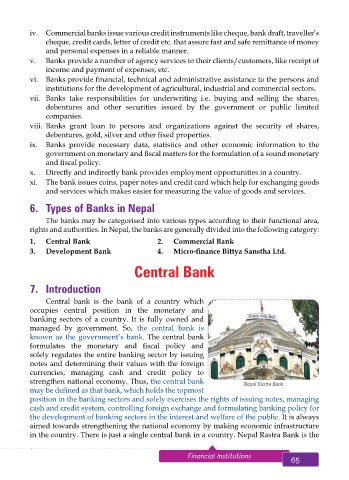
          strengthen national economy. Thus, the central bank         Nepal Rastra Bank
          may be defined as that bank, which holds the topmost
          position in the banking sectors and solely exercises the rights of issuing notes, managing
          cash and credit system, controlling foreign exchange and formulating banking policy for
          the development of banking sectors in the interest and welfare of the public. It is always
          aimed towards strengthening the national economy by making economic infrastructure
          in the country. There is just a single central bank in a country. Nepal Rastra Bank is the


 64  Aakar’s Office Practice and Accountancy - 10     Financial Institutions        65

