


Page 14 - Health, Population and Environment Education 9
P. 14
principles of physics. In chemistry, we learn about chemicals, gases, etc. which can cause
          serious impact in our health. Even several medicines/drugs are made of various chemicals.
          In biology, we learn about our health, body systems, organs, etc. In medicine, students learn
          about human anatomy, physiology, pharmacology, community medicine, pathology, etc.
          which are directly linked with our health. Psychology is related with mind and functioning
          of mind. In home science, we learn about cooking food, maintaining hygiene, preservation of
          nutrients, etc. which directly affect our health. In physical education, we learn about playing
          games. Games have direct impact in our health. The nutrition and health of players affect
          their performance in games. In sociology, we learn about society, social traditions, cultural
          activities, religions, customs, food habits, etc. In many traditions and cultural activities, people
          are encouraged  for smoking, drinking alcohol, taking drugs, consuming too much oily, spicy,
          roasted food items which directly affect our health.

          B.  Scope of population education

          The subject matters or contents related to population and population matters is called as
          scope of population education.
          We can study the scope of population education under five different headings as:


          i.  Demography
          Demography is made up of two Greek terms ‘Demos’ and ‘Graphien’ in which ‘Demos’
          is  people/population  where  as  ‘Graphien’  is  the  study.  Hence,  the  literal  meaning  of
          demography is study of population.
          Demography is the scientific, mathematical and statistical study of population in reference
          to population size, structure, density, composition, distribution, etc.

          ii.  Determinants of population change
          Those factors which determine and are responsible for change of population are called
          determinants of population change. Birth, death and migration are the major determinants
          of population change. Birth increases population and death decreases population whereas
          migration can either increase or decrease the population. Similarly, various socio-cultural,
          biological and environmental factors also determine population.

          iii.  Effects of rapid population growth
          Due to rapid population growth, there is serious
          impact on social, economic and environmental
          sectors. When there is increase of population,
          there is scarcity of facilities like health services,
          education,  sanitation, transportation, etc.  This
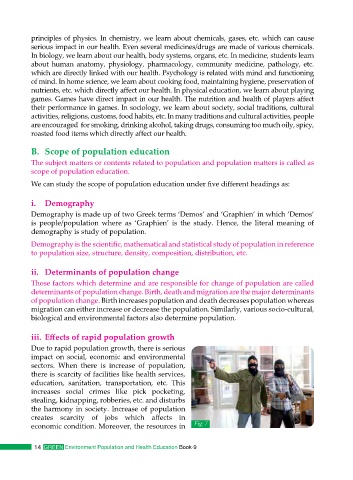
          increases  social  crimes  like pick pocketing,
          stealing, kidnapping, robberies, etc. and disturbs
          the harmony in society. Increase of population
          creates  scarcity  of  jobs  which  affects  in
          economic condition. Moreover, the resources in   Fig: 7


           14  GREEN Environment Population and Health Education Book-9

