


Page 11 - Health, Population and Environment Education 9
P. 11
1.4  Introduction to Environment and Environment Education

            a.  Introduction to environment
            Environment includes everything  surrounding us. There is presence of air, water,
            soil,  minerals,  plants, animals,  birds,  insects,  reptiles,  amphibians, micro-organisms
            including the human beings in the surroundings. Human beings perform various social
            traditions, cultural activities and religious practices in day to day life. These all are parts
            of environment. Air, water, soil and minerals are the abiotic factors and are regarded as
            physical aspects of environment. Plants, animals, birds, insects, micro-organisms, etc. are
            biotic factors and are regarded as biological aspects whereas social traditions, cultural
            activities and religious practices are regarded as socio-cultural aspect. Various human
            activities  as  well  as  other  environmental  resources  are  affected  by  the  moon,  planets,
            stars, satellites and other heavenly bodies. Hence, sky and the entire universe are also the
            environment.
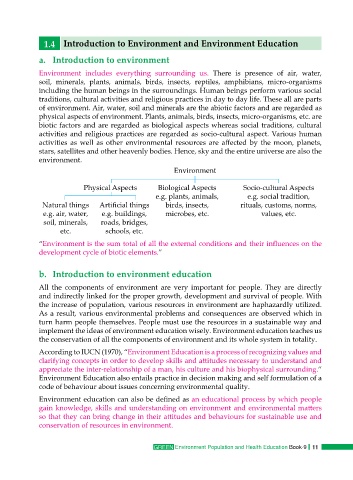
                                                    Environment

                         Physical Aspects      Biological Aspects       Socio-cultural Aspects
                                              e.g. plants, animals,      e.g. social tradition,
             Natural things   Artificial things  birds, insects,       rituals, customs, norms,
              e.g. air, water,   e.g. buildings,   microbes, etc.            values, etc.
              soil, minerals,   roads, bridges,
                   etc.         schools, etc.
            “Environment is the sum total of all the external conditions and their influences on the
            development cycle of biotic elements.”


            b.  Introduction to environment education
            All the components of environment are very important for people. They are directly
            and indirectly linked for the proper growth, development and survival of people. With
            the increase of population, various resources in environment are haphazardly utilized.
            As a result, various environmental problems and consequences are observed which in
            turn harm people themselves. People must use the resources in a sustainable way and
            implement the ideas of environment education wisely. Environment education teaches us
            the conservation of all the components of environment and its whole system in totality.
            According to IUCN (1970), “Environment Education is a process of recognizing values and
            clarifying concepts in order to develop skills and attitudes necessary to understand and
            appreciate the inter-relationship of a man, his culture and his biophysical surrounding.”
            Environment Education also entails practice in decision making and self formulation of a
            code of behaviour about issues concerning environmental quality.

            Environment education can also be defined as an educational process by which people
            gain knowledge, skills and understanding on environment and environmental matters
            so that they can bring change in their attitudes and behaviours for sustainable use and
            conservation of resources in environment.


                                              GREEN  Environment Population and Health Education Book-9 11

