


Page 253 - Health, Population and Environment Education 9
P. 253
3.  Biological risks
            In our surroundings a variety of microbes
            like bacteria, viruses, fungi, protozoans, etc.
            are present. These microbes cause various
            diseases to human beings. Similarly, different
            types  of  vectors  like  mosquito,  sandfly,
            honesty, etc. transmit various  diseases  to
            human beings. Different types miorobes and
            vectors  increase  the risk of diseases  among
            workers in work place. A variety of diseases
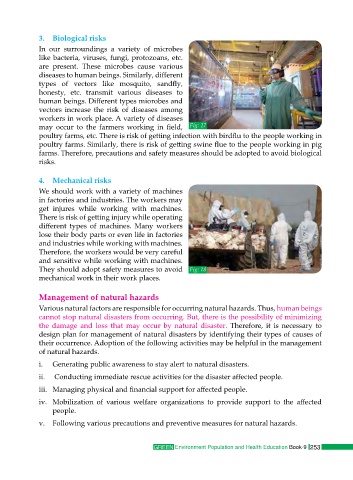
            may  occur  to  the  farmers  working  in  field,   Fig: 17
            poultry farms, etc. There is risk of getting infection with birdflu to the people working in
            poultry farms. Similarly, there is risk of getting swine flue to the people working in pig
            farms. Therefore, precautions and safety measures should be adopted to avoid biological
            risks.


            4.  Mechanical risks
            We should work with a variety of machines
            in factories and industries. The workers may
            get injures while working with machines.
            There is risk of getting injury while operating
            different  types  of  machines.  Many  workers
            lose their body parts or even life in factories
            and industries while working with machines.
            Therefore, the workers would be very careful
            and sensitive while working with machines.
            They should adopt safety measures to avoid  Fig: 18
            mechanical work in their work places.

            Management of natural hazards
            Various natural factors are responsible for occurring natural hazards. Thus, human beings
            cannot stop natural disasters from occurring. But, there is the possibility of minimizing
            the damage and loss that  may occur by  natural  disaster. Therefore, it is necessary to
            design plan for management of natural disasters by identifying their types of causes of
            their occurrence. Adoption of the following activities may be helpful in the management
            of natural hazards.
            i.   Generating public awareness to stay alert to natural disasters.

            ii.    Conducting immediate rescue activities for the disaster affected people.
            iii.  Managing physical and financial support for affected people.
            iv.  Mobilization  of  various  welfare  organizations  to  provide  support  to  the  affected
                people.
            v.  Following various precautions and preventive measures for natural hazards.


                                              GREEN  Environment Population and Health Education Book-9 253

