


Page 249 - Health, Population and Environment Education 9
P. 249
Glacial Lake outburst flood (GLOF)
            A type of outbrust flood that occurs due to
            filling of the dam containing a glacial lake is
            called glacial lake outburst flood. The dam
            of the glacial lake consists of glacier, ice or
            a terminal moraine. Failure of glacial lake
            dam occurs due to erosion, water pressure,
            avalanche,  earthquake,  volcanic  erruption,
            etc.  As  a result, a large amount of glacier
            breaks  off  and  displaces  the  water  in  a
            glacial lake massively. Catastrophic failure
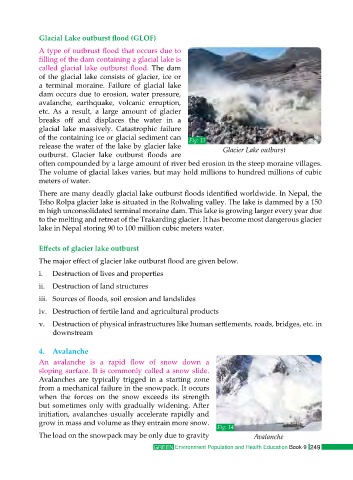
            of the containing ice or glacial sediment can   Fig: 13
            release the water of the lake by glacier lake         Glacier Lake outburst
            outburst.  Glacier  lake  outburst  floods  are
            often compounded by a large amount of river bed erosion in the steep moraine villages.
            The volume of glacial lakes varies, but may hold millions to hundred millions of cubic
            meters of water.
            There are many deadly glacial lake outburst floods identified worldwide. In Nepal, the
            Tsho Rolpa glacier lake is situated in the Rolwaling valley. The lake is dammed by a 150
            m high unconsolidated terminal moraine dam. This lake is growing larger every year due
            to the melting and retreat of the Trakarding glacier. It has become most dangerous glacier
            lake in Nepal storing 90 to 100 million cubic meters water.


            Effects of glacier lake outburst
            The major effect of glacier lake outburst flood are given below.

            i.   Destruction of lives and properties
            ii.  Destruction of land structures
            iii.  Sources of floods, soil erosion and landslides

            iv.  Destruction of fertile land and agricultural products
            v.  Destruction of physical infrastructures like human settlements, roads, bridges, etc. in
                downstream


            4.  Avalanche
            An  avalanche  is  a  rapid  flow  of  snow  down  a
            sloping surface. It is commonly called a snow slide.
            Avalanches are typically  trigged  in a starting  zone
            from a mechanical failure in the snowpack. It occurs
            when the forces  on the snow exceeds  its strength
            but sometimes only with gradually widening. After
            initiation, avalanches usually accelerate rapidly and
            grow in mass and volume as they entrain more snow.
                                                                Fig: 14
            The load on the snowpack may be only due to gravity            Avalanche
                                              GREEN  Environment Population and Health Education Book-9 249

