


Page 92 - Health, Population and Environment Education 9
P. 92
5.2  Family

          Introduction to family
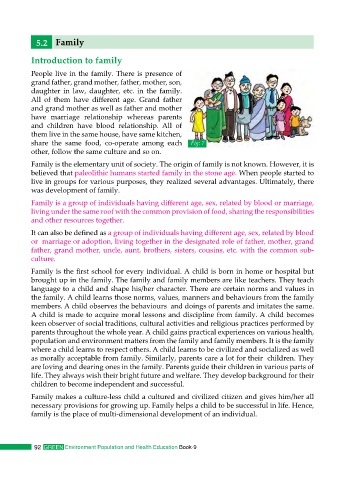
          People live in the family. There is presence of
          grand father, grand mother, father, mother, son,
          daughter in law, daughter, etc. in the family.
          All  of  them  have  different  age.  Grand  father
          and grand mother as well as father and mother
          have marriage relationship whereas parents
          and  children  have  blood  relationship.  All  of
          them live in the same house, have same kitchen,
          share the same food,  co-operate among each    Fig: 7
          other, follow the same culture and so on.
          Family is the elementary unit of society. The origin of family is not known. However, it is
          believed that paleolithic humans started family in the stone age. When people started to
          live in groups for various purposes, they realized several advantages. Ultimately, there
          was development of family.
          Family is a group of individuals having different age, sex, related by blood or marriage,
          living under the same roof with the common provision of food, sharing the responsibilities
          and other resources together.
          It can also be defined as a group of individuals having different age, sex, related by blood
          or  marriage or adoption, living together in the designated role of father, mother, grand
          father, grand mother, uncle, aunt, brothers, sisters, cousins, etc. with the common sub-
          culture.
          Family is the first school for every individual. A child is born in home or hospital but
          brought up in the family. The family and family members are like teachers. They teach
          language to a child and shape his/her character. There are certain norms and values in
          the family. A child learns those norms, values, manners and behaviours from the family
          members. A child observes the behaviours  and doings of parents and imitates the same.
          A child is made to acquire moral lessons and discipline from family. A child becomes
          keen observer of social traditions, cultural activities and religious practices performed by
          parents throughout the whole year. A child gains practical experiences on various health,
          population and environment matters from the family and family members. It is the family
          where a child learns to respect others. A child learns to be civilized and socialized as well
          as morally acceptable from family. Similarly, parents care a lot for their  children. They
          are loving and dearing ones in the family. Parents guide their children in various parts of
          life. They always wish their bright future and welfare. They develop background for their
          children to become independent and successful.
          Family makes a culture-less child a cultured and civilized citizen and gives him/her all
          necessary provisions for growing up. Family helps a child to be successful in life. Hence,
          family is the place of multi-dimensional development of an individual.


           92  GREEN Environment Population and Health Education Book-9

