


Page 92 - Hello-Grammer-6
P. 92
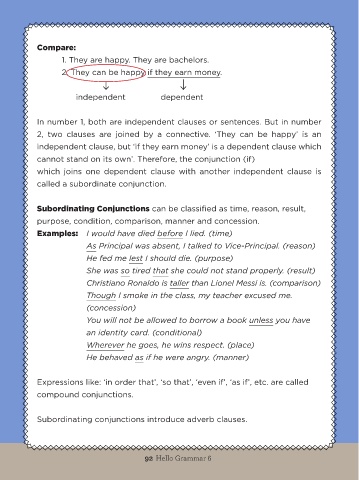
Compare:
                   1. They are happy. They are bachelors.
                   2. They can be happy if they earn money.


                         independent            dependent


            In number 1, both are independent clauses or sentences. But in number
            2, two clauses are joined by a connective. ‘They can be happy’ is an
            independent clause, but ‘if they earn money’ is a dependent clause which
            cannot stand on its own’. Therefore, the conjunction (if)
            which joins one dependent clause with another independent clause is

            called a subordinate conjunction.


            Subordinating Conjunctions can be classified as time, reason, result,

            purpose, condition, comparison, manner and concession.
            Examples:  I would have died before I lied. (time)
                          As Principal was absent, I talked to Vice-Principal. (reason)
                          He fed me lest I should die. (purpose)
                          She was so tired that she could not stand properly. (result)

                          Christiano Ronaldo is taller than Lionel Messi is. (comparison)
                          Though I smoke in the class, my teacher excused me.
                          (concession)

                          You will not be allowed to borrow a book unless you have
                          an identity card. (conditional)
                          Wherever he goes, he wins respect. (place)
                          He behaved as if he were angry. (manner)


            Expressions like: ‘in order that’, ‘so that’, ‘even if’, ‘as if’, etc. are called
            compound conjunctions.


            Subordinating conjunctions introduce adverb clauses.


                                           92  Hello Grammar 6

