


Page 20 - 9 teachers social book 9 @ 2077 ctp_Neat
P. 20
Lesson      Our Identities
            1.5


                            FACTS        Although there are many cultural and ethnic groups
                         to Understand   in Nepal, they always lived in peace and harmony
                                         with each other. There always was tolerance
                                         among the various cultures and no dispute
                                         occurred that could affect the cultural solidarity of
                                         the country.


           Nepal is a small landlocked country in terms of area but there is world within itself.
           There  are 125 ethnic  groups followed by 123 different languages according  to the
           census  2011 AD.  There  are  many typical features  in  our  country  that identify us
           among others. They have been making us distinctive and known to the world. Nepal
           is  enriched  by a number  of identities and the special features.  They  are unique
           and stand as our valuable assets. We must not forget or become negligent in their
           protection and promotion.
           Some unique identities of Nepal are discussed below:


           Natural Identity

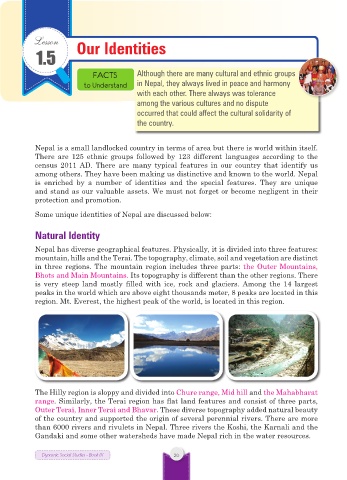
           Nepal has diverse geographical features. Physically, it is divided into three features:
           mountain, hills and the Terai. The topography, climate, soil and vegetation are distinct
           in three regions. The mountain region includes three parts: the Outer Mountains,
           Bhots and Main Mountains. Its topography is different than the other regions. There
           is  very  steep  land  mostly  filled  with  ice,  rock  and  glaciers.  Among  the  14  largest
           peaks in the world which are above eight thousands meter, 8 peaks are located in this
           region. Mt. Everest, the highest peak of the world, is located in this region.


           The Hilly region is sloppy and divided into Chure range, Mid hill and the Mahabharat
           range. Similarly, the Terai region has flat land features and consist of three parts,
           Outer Terai, Inner Terai and Bhavar. These diverse topography added natural beauty
           of the country and supported the origin of several perennial rivers. There are more
           than 6000 rivers and rivulets in Nepal. Three rivers the Koshi, the Karnali and the
           Gandaki and some other watersheds have made Nepal rich in the water resources.


             Dynamic Social Studies - Book IX      20

