


Page 206 - 9 teachers social book 9 @ 2077 ctp_Neat
P. 206
Lesson      Diverse Land Features and
           6.6
                       Lifestyle of Nepal


                            FACTS        “The mountains were so wild and so stark and so
                         to Understand   very beautiful that I wanted to cry. I breathed in
                                         another wonderful moment to keep safe in my heart.
                                           Jane Wilson- Howart (Author: “Snowfed Waters")

           Nepal has a great physical diversity. Various types of climate are experienced here
           according to the land features and altitudinal zone. This differences in landforms and
           climate have made the country rich in bio-diversity and also influenced in lifestyle,
           housing and economic activities, of the people. Different topography and climate are
           found from north and south of Nepal. This differences on topography and climate
           have created differences in economic activities and lifestyle in different geographical
           regions. They are discussed below in details.

           The Mountain Region


           The Himalayan region has harsh climate and difficult land topography. It coves 15% of
           the land area of Nepal. Because of land features the human settlement is very thinly
           populated. Only 7% of the total population is living in the mountain region of Nepal.
                                                                              (Source: CBS 2068)
           It  is the least developed  and less
           facilitate region.  People are  found
           settling in  clustered  hamlets  of
           around 25-30 houses  are one-
           storeyed made up of mud and flat
           roof of stone to protect from cold
           and wind. The mountain region is
           very  windy  so  stone  roof  is  made.
           The population density is very low
           with 34 persons per sq. km.
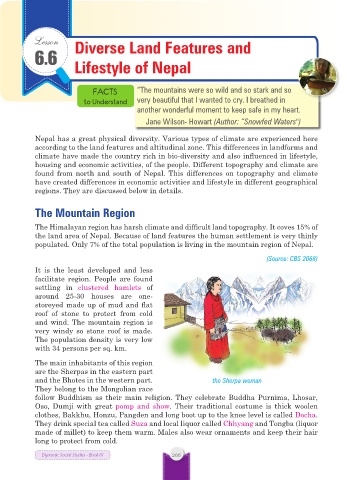
           The main inhabitants of this region
           are the Sherpas in the eastern part
           and the Bhotes in the western part.                 the Sherpa woman
           They belong to the Mongolian race
           follow Buddhism as their main religion. They celebrate Buddha Purnima, Lhosar,
           Oso,  Dumji  with  great  pomp and show.  Their  traditional costume is thick  woolen
           clothes, Bakkhu, Honzu, Pangden and long boot up to the knee level is called Docha.
           They drink special tea called Suza and local liquor called Chhyang and Tongba (liquor
           made of millet) to keep them warm. Males also wear ornaments and keep their hair
           long to protect from cold.

             Dynamic Social Studies - Book IX      206

