


Page 66 - 9 teachers social book 9 @ 2077 ctp_Neat
P. 66
Electricity Generation in Nepal

           Electricity can be generated from different sources like coal, sunlight, wind, water,
           biogas, etc. The  electricity generated from rivers, rivulets,  lakes,  etc.  is called
           hydroelectricity. Hydro or water is the best source since it is cheaper, reliable and
           renewable. The water resource is also called white coal because it is valuable and
           renewable which  can be used and reused.  Hydroelectricity was generated for the
           first  time  in  Nepal  in  1965  BS  during  the  time  of  the  then  Rana  Prime  Minister
           Chandra Shumsher  from  the  Pharping  Hydropower  Project.  Its capacity was
           500  KW.  Gehendra  Shumsher,  the  first  scientist  of  Nepal,  took  the  initiation  to
           generate the electricity. There are more than 6000 big or small, seasonal or perennial
           rivers  are  flowing  through  the  country.  So,  there  is  high  feasibility  to  generate
           electricity. Among the potentiality of producing 83,000 MW of hydroelectricity, only
           three big rivers of Nepal like the Saptakoshi, the Sapta Gandaki and the Karnali
           have  the  capacity to produce  65000 MW.  Besides these,  there  are  many streams,
           perennial  rivulets  from which  micro  projects and pico projects can be operated in
           Nepal. Pico hydroprojects is a term used for hydroelectric power generation of under
           5 KW. It is useful in small, remote communities that requires only a small amount of
           electricity. For example, to power one or two fluorescent lights, bulbs and a TV or in
           about 50 homes.


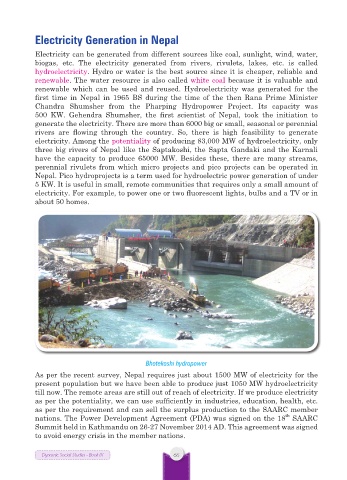
                                           Bhotekoshi hydropower

           As per the recent survey, Nepal requires just about 1500 MW of electricity for the
           present population but we have been able to produce just 1050 MW hydroelectricity
           till now. The remote areas are still out of reach of electricity. If we produce electricity
           as per the potentiality, we can use sufficiently in industries, education, health, etc.
           as per the requirement and can sell the surplus production to the SAARC member
                                                                                    th
           nations. The Power Development Agreement (PDA) was signed on the 18  SAARC
           Summit held in Kathmandu on 26-27 November 2014 AD. This agreement was signed
           to avoid energy crisis in the member nations.


             Dynamic Social Studies - Book IX      66

