


Page 87 - 9 teachers social book 9 @ 2077 ctp_Neat
P. 87
Lesson       Nepali Architecture (Vastukala)
         3.3


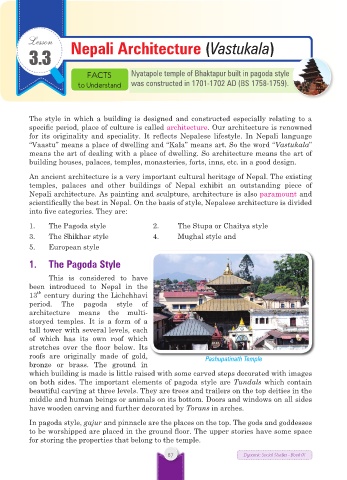
                          FACTS        Nyatapole temple of Bhaktapur built in pagoda style
                        to Understand  was constructed in 1701-1702 AD (BS 1758-1759).


          The style in which a building is designed and constructed especially relating to a
          specific period, place of culture is called architecture. Our architecture is renowned
          for  its  originality  and  speciality.  It  reflects  Nepalese  lifestyle.  In  Nepali  language
          “Vaastu” means a place of dwelling and “Kala” means art. So the word “Vastukala”
          means the art of dealing with a place of dwelling. So architecture means the art of
          building houses, palaces, temples, monasteries, forts, inns, etc. in a good design.

          An ancient architecture is a very important cultural heritage of Nepal. The existing
          temples, palaces  and other buildings of Nepal exhibit an outstanding piece of
          Nepali architecture. As painting and sculpture, architecture is also paramount and
          scientifically the best in Nepal. On the basis of style, Nepalese architecture is divided
          into five categories. They are:
          1.   The Pagoda style               2.     The Stupa or Chaitya style
          3.   The Shikhar style              4.     Mughal style and
          5.   European style

          1.  The Pagoda Style

               This is considered to have
          been introduced to Nepal in the
            th
          13  century during the Lichchhavi
          period.  The   pagoda    style  of
          architecture means the multi-
          storyed temples. It is  a form  of  a
          tall tower with several levels, each
          of  which  has  its  own  roof  which
          stretches  over  the  floor  below.  Its
          roofs  are originally made of gold,                Pashupatinath Temple
          bronze or brass. The ground in
          which building is made is little raised with some carved steps decorated with images
          on both sides. The important elements of pagoda style are Tundals which contain
          beautiful carving at three levels. They are trees and trailers on the top deities in the
          middle and human beings or animals on its bottom. Doors and windows on all sides
          have wooden carving and further decorated by Torans in arches.
          In pagoda style, gajur and pinnacle are the places on the top. The gods and goddesses
          to be worshipped are placed in the ground floor. The upper stories have some space
          for storing the properties that belong to the temple.

                                                  87                    Dynamic Social Studies - Book IX

