


Page 165 - Social Studies 7
P. 165
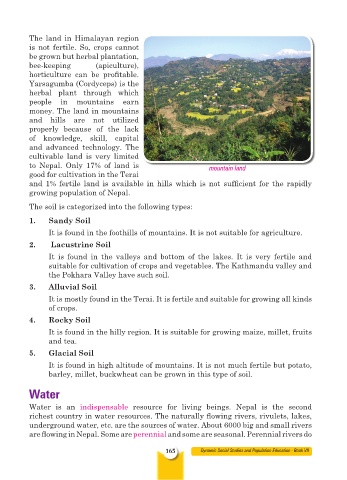
The land in Himalayan region
          is not fertile.  So,  crops cannot
          be grown but herbal plantation,
          bee-keeping        (apiculture),
          horticulture  can  be  profitable.
          Yarsagumba (Cordyceps) is the
          herbal  plant through  which
          people in mountains earn
          money. The land in mountains
          and hills are not utilized
          properly because  of  the  lack
          of knowledge, skill,  capital
          and advanced technology.  The
          cultivable land is very limited
          to Nepal. Only 17% of land is                       mountain land
          good for cultivation in the Terai
          and  1%  fertile  land  is  available  in  hills  which  is  not  sufficient  for  the  rapidly
          growing population of Nepal.

          The soil is categorized into the following types:
          1.   Sandy Soil
               It is found in the foothills of mountains. It is not suitable for agriculture.
          2.    Lacustrine Soil

               It is  found  in  the valleys and bottom of the lakes.  It is  very fertile and
               suitable for cultivation of crops and vegetables. The Kathmandu valley and
               the Pokhara Valley have such soil.
          3.   Alluvial Soil
               It is mostly found in the Terai. It is fertile and suitable for growing all kinds
               of crops.
          4.   Rocky Soil

               It is found in the hilly region. It is suitable for growing maize, millet, fruits
               and tea.
          5.   Glacial Soil

               It is found in high altitude of mountains. It is not much fertile but potato,
               barley, millet, buckwheat can be grown in this type of soil.

          Water

          Water is an  indispensable resource  for living beings. Nepal is the second
          richest country in water resources. The naturally flowing rivers, rivulets, lakes,
          underground water, etc. are the sources of water. About 6000 big and small rivers
          are flowing in Nepal. Some are perennial and some are seasonal. Perennial rivers do

                                                 165       Dynamic Social Studies and Population Education - Book VII

