


Page 166 - Social Studies 7
P. 166
not decrease their volume.
           So,  they can  be utilized
           for drinking, irrigation,
           hydroelectricity and water
           transportation.  The  Koshi,
           the   Gandaki     and    the
           Karnali  are  the  perennial
           rivers  in  Nepal.  Tourism
           can be developed due to the
           availability of water such as
           boating, rafting,  canoeing,
           etc. The great Himalayas
           in the north have gifted
           us  many  perennial  rivers.
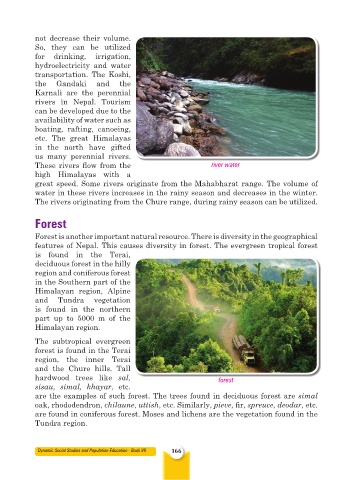
           These rivers flow from the                          river water
           high Himalayas with a
           great speed. Some rivers originate from the Mahabharat range. The volume of
           water in these rivers increases in the rainy season and decreases in the winter.
           The rivers originating from the Chure range, during rainy season can be utilized.

           Forest

           Forest is another important natural resource. There is diversity in the geographical
           features of Nepal. This causes diversity in forest. The evergreen tropical forest
           is found in the Terai,
           deciduous forest in the hilly
           region and coniferous forest
           in the Southern part of the
           Himalayan region, Alpine
           and    Tundra    vegetation
           is  found  in  the northern
           part up to 5000 m of the
           Himalayan region.
           The  subtropical  evergreen
           forest is found in the Terai
           region, the inner Terai
           and the  Chure  hills.  Tall
           hardwood trees like  sal,                             forest
           sisau,  simal, khayar, etc.
           are the examples of such forest. The trees found in deciduous forest are simal
           oak, rhododendron, chilaune, uttish, etc. Similarly, pieve, fir, spreuce, deodar, etc.
           are found in coniferous forest. Moses and lichens are the vegetation found in the
           Tundra region.


            Dynamic Social Studies and Population Education - Book VII  166

