


Page 97 - Social Studies 5
P. 97
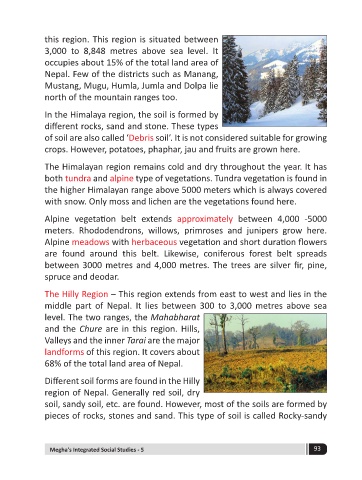
this region. This region is situated between
              3,000  to  8,848  metres  above  sea  level.  It
              occupies about 15% of the total land area of
              Nepal. Few of the districts such as Manang,
              Mustang, Mugu, Humla, Jumla and Dolpa lie
              north of the mountain ranges too.


              In the Himalaya region, the soil is formed by
              different rocks, sand and stone. These types
              of soil are also called ‘Debris soil’. It is not considered suitable for growing
              crops. However, potatoes, phaphar, jau and fruits are grown here.

              The Himalayan region remains cold and dry throughout the year. It has
              both tundra and alpine type of vegetations. Tundra vegetation is found in
              the higher Himalayan range above 5000 meters which is always covered

              with snow. Only moss and lichen are the vegetations found here.

              Alpine  vegetation  belt  extends  approximately  between  4,000  -5000
              meters.  Rhododendrons,  willows,  primroses  and  junipers  grow  here.
              Alpine meadows with herbaceous vegetation and short duration flowers
              are  found  around  this  belt.  Likewise,  coniferous  forest  belt  spreads
              between 3000 metres and 4,000 metres. The trees are silver fir, pine,
              spruce and deodar.

              The Hilly Region – This region extends from east to west and lies in the
              middle  part  of  Nepal.  It  lies  between  300  to  3,000  metres  above  sea
              level. The two ranges, the Mahabharat

              and the Chure are in this region. Hills,
              Valleys and the inner Tarai are the major
              landforms of this region. It covers about
              68% of the total land area of Nepal.

              Different soil forms are found in the Hilly
              region of Nepal. Generally red soil, dry
              soil, sandy soil, etc. are found. However, most of the soils are formed by
              pieces of rocks, stones and sand. This type of soil is called Rocky-sandy


                Megha's Integrated Social Studies - 5                                       93

