


Page 98 - Social Studies 5
P. 98
soil too. This type of soil is not suitable for agriculture. However, potatoes,
           barley, Phaphar, millet, etc. can be grown. Tea, coffee, cardamom and
           fruits are also grown in some part of this region.

           The hilly region has temperate climate. The winter is cold and the summer

           is hot. Temperate deciduous vegetations are found mostly in the hilly
           region. This type of vegetation usually sheds leaves during winter and
           become green again during warm climate of rainy summer. Pine, beech,
           elm Katus, Utish, Lapsi, Okhar and Rhododendron are found in this belt.


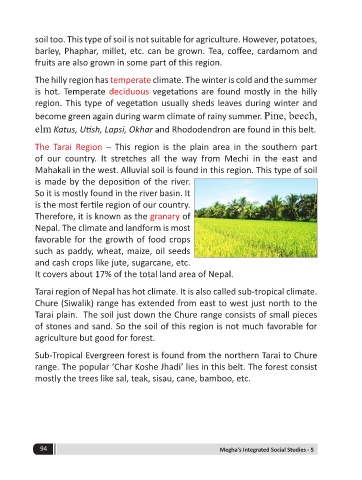
           The  Tarai  Region  –  This  region  is  the  plain  area  in  the  southern  part
           of  our  country.  It  stretches  all  the  way  from  Mechi  in  the  east  and
           Mahakali in the west. Alluvial soil is found in this region. This type of soil
           is made by the deposition of the river.
           So it is mostly found in the river basin. It
           is the most fertile region of our country.
           Therefore, it is known as the granary of
           Nepal. The climate and landform is most
           favorable for the growth of food crops
           such as paddy, wheat, maize, oil seeds
           and cash crops like jute, sugarcane, etc.

           It covers about 17% of the total land area of Nepal.

           Tarai region of Nepal has hot climate. It is also called sub-tropical climate.
           Chure (Siwalik) range has extended from east to west just north to the
           Tarai plain.  The soil just down the Chure range consists of small pieces
           of stones and sand. So the soil of this region is not much favorable for
           agriculture but good for forest.

           Sub-Tropical Evergreen forest is found from the northern Tarai to Chure

           range. The popular ‘Char Koshe Jhadi’ lies in this belt. The forest consist
           mostly the trees like sal, teak, sisau, cane, bamboo, etc.


             94                                                  Megha's Integrated Social Studies - 5

