


Page 130 - Office Practice and Accounting 10
P. 130
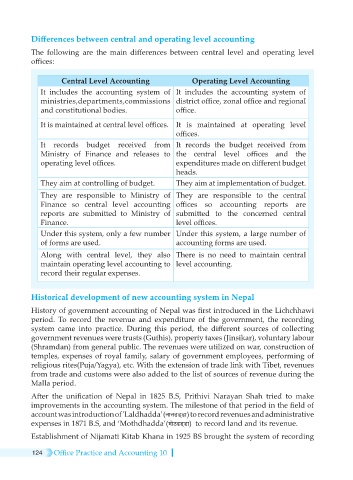
Differences between central and operating level accounting
          The  following  are  the  main  differences  between  central  level  and  operating  level
          offices:


                   Central Level Accounting              Operating Level Accounting
             It  includes  the  accounting  system  of  It  includes  the  accounting  system  of
             ministries,departments,commissions  district office, zonal office and regional
             and constitutional bodies.             office.

             It is maintained at central level offices. It  is  maintained  at  operating  level
                                                    offices.
             It  records  budget  received  from  It  records  the  budget  received  from
             Ministry  of  Finance  and  releases  to  the  central  level  offices  and  the
             operating level offices.               expenditures made on different budget
                                                    heads.
             They aim at controlling of budget.     They aim at implementation of budget.
             They  are  responsible  to  Ministry  of  They  are  responsible  to  the  central
             Finance  so  central  level  accounting  offices  so  accounting  reports  are
             reports  are  submitted  to  Ministry  of  submitted  to  the  concerned  central
             Finance.                               level offices.
             Under this system, only a few number  Under this system, a large number of
             of forms are used.                     accounting forms are used.
             Along  with  central  level,  they  also  There  is  no  need  to  maintain  central
             maintain operating level accounting to  level accounting.
             record their regular expenses.


          Historical development of new accounting system in Nepal
          History of government accounting of Nepal was first introduced in the Lichchhawi
          period.  To  record  the  revenue  and  expenditure  of  the  government,  the  recording
          system  came  into  practice.  During  this  period,  the  different  sources  of  collecting
          government revenues were trusts (Guthis), property taxes (Jinsikar), voluntary labour
          (Shramdan) from general public. The revenues were utilized on war, construction of
          temples, expenses of royal family, salary of government employees, performing of
          religious rites(Puja/Yagya), etc. With the extension of trade link with Tibet, revenues
          from trade and customs were also added to the list of sources of revenue during the
          Malla period.
          After  the  unification  of  Nepal  in  1825  B.S,  Prithivi  Narayan  Shah  tried  to  make
          improvements in the accounting system. The milestone of that period in the field of
          account was introduction of 'Laldhadda' (nfn98\8f) to record revenues and administrative
          expenses in 1871 B.S, and ‘Mothdhadda’(df]798\8f)  to record land and its revenue.
          Establishment of Nijamati Kitab Khana in 1925 BS brought the system of recording


          124    Office Practice and Accounting 10

