


Page 26 - Math 7
P. 26
Number Systems in Diff erent Bases

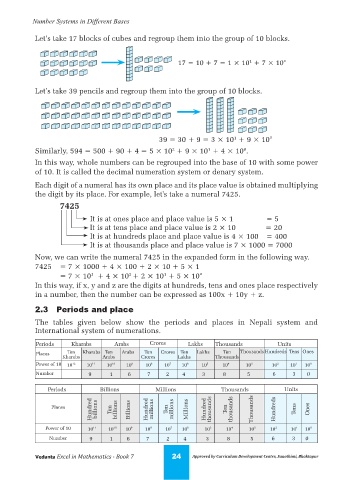
           Let’s take 17 blocks of cubes and regroup them into the group of 10 blocks.


                                                     17 = 10 + 7 = 1 × 10  + 7 × 10°
                                                                          1


           Let’s take 39 pencils and regroup them into the group of 10 blocks.


                                                                     1
                                               39 = 30 + 9 = 3 × 10  + 9 × 10°
                                                                        0
           Similarly, 594 = 500 + 90 + 4 = 5 × 10  + 9 × 10  + 4 × 10 .
                                                   2
                                                             1
           In this way, whole numbers can be regrouped into the base of 10 with some power
           of 10. It is called the decimal numeration system or denary system.
           Each digit of a numeral has its own place and its place value is obtained multiplying
           the digit by its place. For example, let's take a numeral 7425.
                  7425

                           It is at ones place and place value is 5 × 1        = 5
                           It is at tens place and place value is 2 × 10       = 20
                           It is at hundreds place and place value is 4 × 100   = 400
                           It is at thousands place and place value is 7 × 1000 = 7000
           Now, we can write the numeral 7425 in the expanded form in the following way.
           7425  = 7 × 1000 + 4 × 100 + 2 × 10 + 5 × 1
                  = 7 × 10   + 4 × 10 + 2 × 10  + 5 × 10°
                            3
                                       2
                                                 1
           In this way, if x, y and z are the digits at hundreds, tens and ones place respectively
           in a number, then the number can be expressed as 100x + 10y + z.
           2.3  Periods and place

           The tables given below show the periods and places in Nepali system and
           International system of numerations.


                           9     1    6     7    2    4     3     8      5      6     3   0


                           9     1    6     7    2    4      3     8      5     6     3   0

           Vedanta Excel in Mathematics - Book 7   24    Approved by Curriculum Development Centre, Sanothimi, Bhaktapur

