


Page 31 - Math 7
P. 31
Number Systems in Diff erent Bases

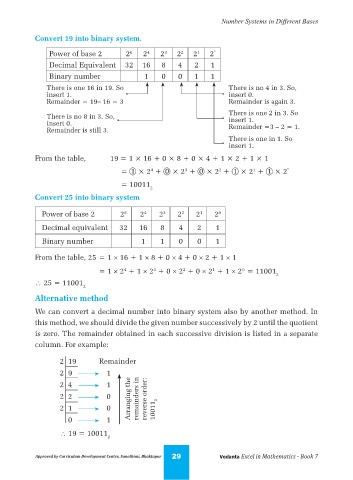
           Convert 19 into binary system.

               Power of base 2        2 6  2 4  2 3  2 2  2 1  2 °
               Decimal Equivalent  32     16    8    4    2   1
               Binary number               1    0    0    1   1
               There is one 16 in 19. So                           There is no 4 in 3. So,
               insert 1.                                           insert 0.
               Remainder = 19– 16 = 3                              Remainder is again 3.
                                                                   There is one 2 in 3. So
               There is no 8 in 3. So,                             insert 1.
               insert 0.                                           Remainder =3 – 2 = 1.
               Remainder is still 3.
                                                                   There is one in 1. So
                                                                   insert 1.
           From the table,       19 = 1 × 16 + 0 × 8 + 0 × 4 + 1 × 2 + 1 × 1
                                    = 1 × 2  +  0 × 2  +  0 × 2  +  1 × 2  +  1 × 2 °
                                                       3
                                             4
                                                                           1
                                                                 2
                                    = 10011
                                             2
           Convert 25 into binary system
             Power of base 2        2 5   2 4  2 3   2 2  2 1  2 0
             Decimal equivalent     32   16     8    4    2     1

             Binary number                1     1    0    0     1

           From the table, 25 = 1 u 16 + 1 u 8 + 0 u 4 + 0 u 2 + 1 u 1
                              = 1 u 2  + 1 u 2  + 0 u 2  + 0 u 2  + 1 u 2q = 11001
                                                      2
                                              3
                                     4
                                                               1
                                                                                 2
           ? 25 = 11001
                         2
           Alternative method
           We can convert a decimal number into binary system also by another method. In
           this method, we should divide the given number successively by 2 until the quotient
           is zero. The remainder obtained in each successive division is listed in a separate
           column. For example:

                  2  19           Remainder
                  2 9          1
                  2 4          1
                  2 2          0       Arranging the   remainders in   reverse order:
                  2 1          0              10011 2
                   0           1

                  ? 19 = 10011  2


           Approved by Curriculum Development Centre, Sanothimi, Bhaktapur  29  Vedanta Excel in Mathematics - Book 7

