


Page 147 - Health, Population and Environment Education 10
P. 147
x.  Occurrence of undigested food particles in the stool
            xi.  Foul smell in the stool
            xii.  Swelling of abdomen

            xiii. Dehydration


            If  a  person  suffers  from  diarrhoea  for  a  long  time,  dehydration  occurs  which  shows
            following symptoms.
            i.   Sunken eyes

            ii.  Mouth becomes dry.
            iii.  The patient feels thirsty.
            iv.  The amount of urine decreases.
            v.  Wrinkles are seen in the skin.


            Preventive and Control Measures
            i.   Consumption of contaminated food and drinks should be avoided.
            ii.  Consumption of raw foods without washing properly should be avoided.
            iii.  Defecation in open fields and near the water sources should be avoided.

            iv.  We should defecate only in toilets.
            v.  Flies should be controlled.
            vi.  We should wash hands properly with soap and water before having food and after
                visiting toilet.
            vii.  Proper health education should be given.
            viii. Food and water should be prevented from contamination.


            2.  Dysentery
            Dysentery is a very common disease which equally affects
            the people of all age groups (i.e. children  to adults). In
            dysentery, blood and mucus  are seen  in the stool  of the
            patient.
            Dysentery is caused by amoeba (i.e. Entamoeba histolytica)
            and bacteria (i.e.  Shigella). The germs of dysentery are
            found in the stool of the patient. These germs enter our
            body through contaminated food and water.
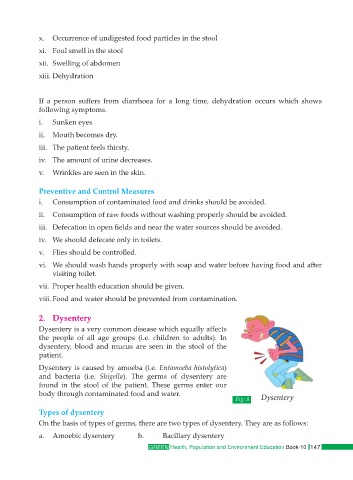
                                                                      Fig: 8  Dysentery
            Types of dysentery
            On the basis of types of germs, there are two types of dysentery. They are as follows:
            a.  Amoebic dysentery        b.     Bacillary dysentery
                                            GREEN  Health, Population and Environment Education Book-10 147

