


Page 174 - Health, Population and Environment Education 10
P. 174
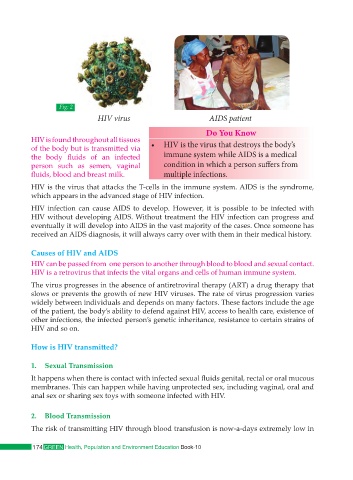
Fig: 2
                             HIV virus                        AIDS patient

                                                             Do You Know
          HIV is found throughout all tissues
          of the body but is transmitted via   •  HIV is the virus that destroys the body’s
          the  body  fluids  of  an  infected    immune system while AIDS is a medical
          person such as semen, vaginal          condition in which a person suffers from
          fluids, blood and breast milk.         multiple infections.
          HIV is the virus that attacks the T-cells in the immune system. AIDS is the syndrome,
          which appears in the advanced stage of HIV infection.
          HIV infection  can  cause AIDS  to  develop.  However,  it is  possible  to be infected  with
          HIV without developing AIDS. Without treatment the HIV infection can progress and
          eventually it will develop into AIDS in the vast majority of the cases. Once someone has
          received an AIDS diagnosis, it will always carry over with them in their medical history.

          Causes of HIV and AIDS
          HIV can be passed from  one person to another through blood to blood and sexual contact.
          HIV is a retrovirus that infects the vital organs and cells of human immune system.

          The virus progresses in the absence of antiretroviral therapy (ART) a drug therapy that
          slows or prevents the growth of new HIV viruses. The rate of virus progression varies
          widely between individuals and depends on many factors. These factors include the age
          of the patient, the body’s ability to defend against HIV, access to health care, existence of
          other infections, the infected person’s genetic inheritance, resistance to certain strains of
          HIV and so on.

          How is HIV transmitted?

          1.  Sexual Transmission

          It happens when there is contact with infected sexual fluids genital, rectal or oral mucous
          membranes. This can happen while having unprotected sex, including vaginal, oral and
          anal sex or sharing sex toys with someone infected with HIV.


          2.  Blood Transmission
          The risk of transmitting HIV through blood transfusion is now-a-days extremely low in

          174  GREEN Health, Population and Environment Education Book-10

