


Page 181 - Health, Population and Environment Education 10
P. 181
Gonorrhoea : At a glance
             Speciality              : Infectious disease
             Causative agent         : Neisseria gonorrhoea
             Modes of transmission   : Unsafe sexual contact with the infected partner
             Symptoms                : None, burning with urination, vaginal discharge, discharge
                                        from the penis, pelvic pain, testicular pain
             Diagnosis               : Testing with urine, urethra in males or cervix in females
             Prevention              : Condoms, having sex with  only one partner  who is
                                        uninfected, not having sex with infected partner
             Treatment               : Ceftriaxone by injection and azithromycin by mouth

            Gonorrhoea is spread through sexual contact with an infected person. This includes oral,
            anal and vaginal sex. It can also spread from a mother to a child during birth.

            Gonorrhoea affects about 0.8% of women and 0.6% of men. An estimated 33 to 106 million
            new cases occur each year, out of the 498 million new cases curable STI- which also
            includes Syphilis, Chlamydia and Trichomoniasis. Infections in women most commonly
            occur when they are young adults.
            Gonorrhoea affects both males and females. This disease infects urethra, rectum, eyes,
            throat, etc. It produces lesions around urethra. It may also affect epididymis and inner
            part of uterus. The person having gonorrhoea has an increased risk of getting infected
            with syphilis and other STI’s.


            Modes of Transmission
            i.   Through unsafe sexual intercourse with the infected partner

            ii.  Contact with the materials used by the patient
            iii.  Through contaminated blood transfusion
            iv.  Through contaminated needle, razor, blade, syringe, etc.

            v.  From infected mother to her unborn child

            Major Symptoms
            i.   Frequent urination
            ii.  Burning sensation while urinating

            iii.  Vaginal discharge
            iv.  Discharge from penis
            v.  Swelling of urethra and difficulty in urination
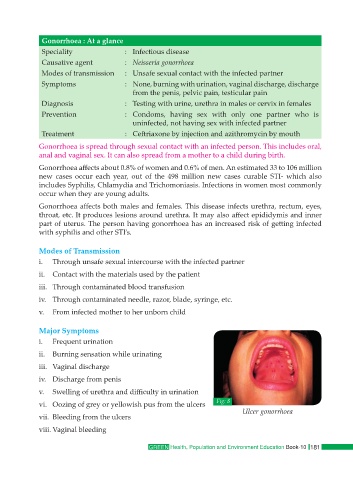
            vi.  Oozing of grey or yellowish pus from the ulcers  Fig: 8
                                                                       Ulcer gonorrhoea
            vii.  Bleeding from the ulcers
            viii. Vaginal bleeding

                                            GREEN  Health, Population and Environment Education Book-10 181

