


Page 244 - Health, Population and Environment Education 10
P. 244
f.  High Altitude Sickness
          Atmospheric  pressure decreases  as we go upwards
          from the sea level. In high altitude, our body cannot
          get  sufficient  oxygen  necessary  for  respiration.  As  a
          result, our brain gets adverse effect due to the lack of
          adequate oxygen required for breathing. The situation
          of our body characterized by nuasea, rapid heart beat,
          difficulty in breathing, headache, etc. as we climb up
          high altitude is called high altitude sickness. Generally,
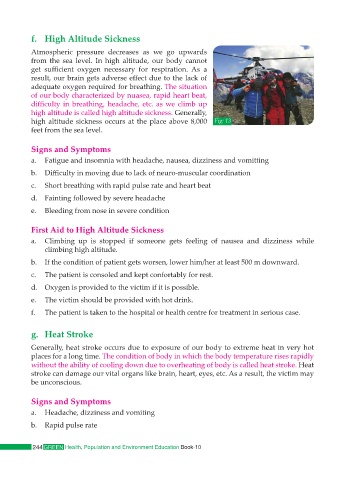
          high altitude sickness occurs at the place above 8,000  Fig: 13
          feet from the sea level.

          Signs and Symptoms
          a.  Fatigue and insomnia with headache, nausea, dizziness and vomitting
          b.  Difficulty in moving due to lack of neuro-muscular coordination

          c.  Short breathing with rapid pulse rate and heart beat
          d.  Fainting followed by severe headache
          e.  Bleeding from nose in severe condition


          First Aid to High Altitude Sickness
          a.  Climbing up is  stopped if someone  gets feeling of  nausea  and  dizziness  while
              climbing high altitude.

          b.  If the condition of patient gets worsen, lower him/her at least 500 m downward.
          c.  The patient is consoled and kept confortably for rest.
          d.  Oxygen is provided to the victim if it is possible.

          e.  The victim should be provided with hot drink.
          f.   The patient is taken to the hospital or health centre for treatment in serious case.


          g.  Heat Stroke
          Generally, heat stroke occurs due to exposure of our body to extreme heat in very hot
          places for a long time. The condition of body in which the body temperature rises rapidly
          without the ability of cooling down due to overheating of body is called heat stroke. Heat
          stroke can damage our vital organs like brain, heart, eyes, etc. As a result, the victim may
          be unconscious.


          Signs and Symptoms
          a.  Headache, dizziness and vomiting
          b.  Rapid pulse rate


          244  GREEN Health, Population and Environment Education Book-10

